Abu-Jamal Attorney Responds to Philly DA
Is the DA afraid the Third Circuit will grant a new trial?
As reported in two recent Associated Press articles April 6 and April 16, the Philadelphia District Attorney has filed a motion asking the entire 3rd U.S. Circuit Court of Appeals to recuse itself from black death-row journalist Mumia Abu-Jamal's case on grounds that Gov. Ed Rendell, whose wife serves on the court, was district attorney during Abu-Jamal's 1982 trial. The DA argues that if the court rules unfavorably for Abu-Jamal, the defendant could then argue that the ruling was a result of bias from the court, and as the Associated Press wrote, the DA allegedly "wants to leave Abu-Jamal no grounds for any future appeal."
Assistant District Attorney Hugh J. Burns Jr. wrote in his motion that since "Mr. Rendell was the elected district attorney at the time in question, and so would have been responsible for the supposed 'routine' racially discriminatory practices of Philadelphia prosecutors, Abu-Jamal's accusations necessarily implicate Mr. Rendell personally,"
This request followed the March 22 announcement that Abu-Jamal would have oral arguments in Philadelphia on May 17, where the court will consider four different issues that have already been certified for appeal. Supporters have already begun organizing a mass-demonstration in Philadelphia on May 17, and many feel that the DA's request is actually designed 1) to delay the oral arguments and 2) to move Abu-Jamal's case to a more conservative circuit that will be less sympathetic to the issues being presented for a new trial.
Abu-Jamal's attorney, Robert R, Bryan, strongly opposed this move by the District Attorney and filed his response with the court on April 13.
In this interview (conducted on April 16), Bryan responds to this recent move from the DA and provides background on the issues being considered on May 17.
San Francisco attorney Robert R. Bryan has appeared as chief counsel in numerous murder cases and specializes in death-penalty litigation. He is a member of the bar of the United States Supreme Court, California, New York, Alabama, various federal courts, and is the former Chair of the National Coalition to Abolish the Death Penalty, Washington, DC.
Mumia Abu-Jamal first began writing Mr. Bryan in 1986 and in 1991 formally asked him to take his case. The attorney had to decline at that time due to a full schedule of other capital case commitments. In 2003 Mr. Bryan was again approached, and finally agreed to become lead counsel for Mr. Abu-Jamal. He can be contacted via email: RobertRBryan@aol.com
Hans Bennett: Last week, you filed a response to the DA's request to have the 3rd Circuit Court recuse itself? What's this all about?
Robert R. Bryan: I was surprised that the Philadelphia District Attorney actually asked for the disqualification of every judge on the U.S. Court of Appeals for the Third Circuit. This seems really over the top. On Friday, April 13, I filed a response aggressively opposing this effort by the DA. One of my concerns is that the prosecution not be allowed to use this ploy to delay oral argument which is set for May 17.
Mumia has been locked up for over a quarter of a century and on death row for 24. This day for oral arguments has been a long time coming and we do not want justice delayed. That is the bottom line. Also, I feel that this court can be fair. The grounds presented by the DA for disqualification of every judge are baseless and absurd.
I have been doing death penalty work for three decades and this is a novel approach. Of course, in some cases a judge might not be fair and must be disqualified. An example would be when I reopened in New Jersey the Hauptmann-Lindbergh Trial of the Century on behalf of Anna Hauptmann, the widow of Richard Hauptmann. He was executed in 1936 for the kidnap-murder of Charles A. Lindbergh, Jr.; that was long before I was born. In the 1980s I uncovered evidence suppressed by the government establishing that Mr. Hauptmann was in fact innocent. We were litigating the case in the U.S. District Court, Newark. I asked for the recusal of the judge assigned to the case in the belief he could not be fair because his father had been involved in the initial 1932 Lindbergh kidnap investigation as a police chief.
Recusal is statutorily required where a judge has a personal bias or prejudice concerning a party, or personal knowledge of disputed facts, or where there is the appearance of impropriety. However, I do not see those conditions in the case of Mumia Abu-Jamal, where the DA wants to disqualify not just one judge, but rather the entire court.
Bennett: Has the three-judge panel even been selected yet?
Bryan: No. We do not at this point know whom the three judges will be to hear and decide the case. For the District Attorney to be asking for disqualification under the circumstances seems absurd.
Bennett: In December, 2005, the U.S. Court of Appeals shocked many by agreeing to consider two claims not "certified for appeal" by Judge Yohn in 2001. Do you think the DA is threatened by the 3rd Circuit because they may fairly consider the issues and grant your client a new trial?
Bryan: The prosecution seems intent on doing just about anything to avoid that result: a new trial not riddled with racism. The DA's efforts seem not only for the purpose of delaying the May 17 oral argument, but is also a transparent attempt to maneuver the case into being heard by really conservative judges from other circuits. This court, the Third Circuit, has a reputation for being fair and evenhanded, much more than some of the other courts. That is all Mumia and I want—fairness.
The United States is divided into different circuits. This particular circuit is known for being just, particularly when there have been constitutional abuses and has been willing to grant relief. It is clear what the DA is trying to do. The prosecution wants Mumia's case out of the Third Circuit and heard instead by judges from elsewhere who are more conservative and less concerned about constitutional violations, particularly with death penalty cases such as this.
A word of caution. Being in the Third Circuit certainly does not guarantee a favorable outcome. What Mumia and I want is that his case be fairly heard and adjudged. If that occurs then we have a good chance of being granted a new trial, since the constitutional violations are so egregious. Racism and unfairness are threads that have run through this case since the beginning.
Bennett: In 2003 a state court ruled against considering court stenographer Terry Maurer-Carter's affidavit. Since this time, have you been able to include her affidavit in the current federal appeal, despite the state ruling?
Bryan: Ms. Maurer-Carter came forward in August, 2001 with startling new evidence. She revealed that during the 1982 trial she overheard Judge Albert Sabo state, in reference to Mumia, that he was going to help "fry the nigger." Her sworn declaration was immediately filed in the U.S. District Court. Three weeks later on September 17, 2001, a motion was filed federally in an effort to expand the judicial bias claim, contending that the newly discovered evidence established the judge "was racially prejudiced" against Mumia. The evidence also was submitted to the state court, and then as part of a petition I filed March 8, 2004 in the United States Supreme Court. The issue we presented was whether it is permissible under the Fifth, Sixth and Fourteenth Amendments for a judge to preside over a capital murder trial in which he was overheard stating in reference to the accused that he was going to help "fry the nigger." Just quoting those horrible words of Judge Sabo sends chills down my spine.
Bennett: You have included her statement in your current 3rd Circuit appeal, in particular regarding the fourth issue being considered: Judge Sabo's unfairness at the 1995 PCRA evidentiary hearings.
Bryan: Yes. We have four issues in this case and this one concerns Judge Sabo's bias, not at the 1982 trial, but during the 1995 post-conviction (PCRA) evidentiary hearing. I am stuck with that limitation since the lawyers previously on the case did not as a matter of law accuse Judge Sabo of bias at the trial. The judge who was deciding whether or not to grant a new trial in 1995 was the same person who presided over the 1982 trial in which my client was convicted and sentenced to death. Judge Yohn assumed as part of his federal rulings in 2001, that in denying relief Judge Sabo was impartial and fair. Now we know that was not true. When it came to Mumia Abu-Jamal, Judge Sabo made a bigoted remark that he was intent on seeing my client "fry", to be executed. The constitutional principles of due process, fundamental fairness, and equal protection of the law, had taken a holiday from his courtroom. As you know, Mumia has been on death row ever since the trial.
Aside from the numerous violations of my client's constitutional rights detailed in our briefs, we also have this evidence that Judge Sabo said he was going to help the prosecution kill my client, referring to him in the most racist and despicable manner imaginable.
Sabo's "fry the nigger" comment is interrelated with what we are arguing on May 17, but it is not the sole basis of the argument that Judge Sabo was unfair at the 1995 hearing. But it is now part of it and we put it in because it was raised shortly following discovery, and was presented to the U.S. District Court. So I feel it is legitimately there before the Court of Appeals.
As you know, I have litigated numerous death penalty cases around the country for three decades. Back when I was trying many cases in the South, I went before some very racist judges. One even jailed me three days for contempt of court for challenging his racism and bias. Incidentally, my client was cleared—acquitted of murder and all related charges. With all the racism I have witnessed, never have I been before someone who was so arrogant about his or her racism as to just openly talk about it. Mumia's case occurred not in the South, but in Philadelphia, which, aside from the police department, is a sophisticated city. Yet, in this case Judge Sabo refers to Mumia as a "nigger" and boasts about helping the prosecution ensure that he is executed. This is the big gorilla in the room that must be addressed; it cannot be ignored.
Bennett: It's remarkable that Judge Pamela Dembe ruled in 2001 that even if Maurer-Carter was correct, it simply does not matter. She said that since it "was a jury trial, as long as the presiding judge's rulings were legally correct, claims as to what might have motivated or animated those rulings are not relevant."
Bryan: I feel that as a matter of law Judge Dembe was wrong, and of course rejecting that she employed faulty judgment. The subsequent ruling by the Pennsylvania Supreme Court, which I took to the United State Supreme Court, was likewise based upon illogical reasoning. Nevertheless, as I mentioned earlier, this issue was also presented during the same period in the U.S. District Court. The sworn declaration of Terri Maurer-Carter was promptly filed federally.
It is interesting that Ms. Maurer-Carter's husband was a police officer and she an official court stenographer who has received awards for the excellence for her court-reporting work. She is just a normal personal, not political, but what Ms. Maurer-Carter overheard really bothered her. I have great respect for her, that she had the courage to come forward with this information. Ms. Maurer-Carter could have remained silent and stayed out of this, and she and her family would certainly feel safer at night.
Bennett: Do you have an estimate of you how long it will take for the 3rd Circuit Court to make the ruling on a new trial?
Bryan: It is difficult to say. The court has a goal of having an internal draft decision within 60 days following assignment or all supplemental briefing. Yet, if a judge on the panel wishes to concur or dissent, he or she should submit the opinion within 45 days after a second judge's approval of the majority decision. These are only targets the court sets for itself so it could reach a decision much quicker, or longer. I hope to have a ruling before the end of the summer, but that depends upon what happens internally with the court; it could be sometime in the fall. I do not think it will sit on this case for a long time. This is a court not known to procrastinate and hold up the wheels of justice.
Bennett: What rulings could the court make?
Bryan: I will give you the two extremes of what might happen: (1) If the court decides that Mumia deserves a new trial, the judges might order a retrial. (2) If the court rules against us on everything, it we would be looking down the barrel of an execution and need to petition the United States Supreme Court. Of course, there are various rulings the court could make between these two extremes, such as sending the case back to a lower court for further hearings, only ordering a retrial on the issues of life or death, etc.
The issues in this case are of great constitutional importance. In additional to the work by associate counsel Professor Judith L. Ritter and me, there has been support from highly respected legal organizations. The NAACP Legal Defense Fund has written a friend of the court brief on the "racism-in-jury-selection" issue. There was also a brief filed by the National Lawyers Guild, which has been joined by the National Conference of Black Lawyers, International Association of Democratic Lawyers, Charles Hamilton Houston Institute of Race and Justice at Harvard Law School, the Southern Center for Human Rights, and the National Jury Project. That is quite a list of human rights-oriented organizations arguing that this case cries for a new and fair trial not riddled with racism, as it was initially.
Bennett: What can supporters around the world do to best aid your battle in the courts?
Bryan: People need to openly express their concern for human rights, opposition to the death penalty, and demand what we are after in this case: a completely new trial, at the conclusion of that trial, my client could go home to his family. That is the bottom line, and that is what's driving me and the legal team: Mumia's ultimate freedom.
That being said, I consider it very important that people's voices are heard in many ways, like peacefully demonstrating, writing letters to newspaper editors, op-ed pieces, news articles. It is really like what you, Hans, are doing: just getting the word out publicly about the injustices that have occurred in this case—letting the facts speak for themselves. That is what people can do. Of course we need financial support for the legal effort, and there is a fund strictly for the legal defense, the Committee To Save Mumia Abu-Jamal (see below).
The big thing is that that people's voices are heard. I was in Berlin, Germany, in January and spoke to an audience of well over two thousand people. The audience's boisterous reaction to my remarks was overwhelming—they recognized the importance of Mumia to the cause of people's basic rights. There is also much activism in many other countries, such as France, England, Spain, Italy. Mumia Abu-Jamal has become a worldwide symbol in the struggle against the death penalty, and against human rights abuses.
When arrested Mumia was a prominent journalist who was known as the Voice of the Voiceless, because he spoke out against governmental abuses and corruption. The authorities thought when they prosecuted and put him on death row, they would silence him. Ironically he is heard by more people today through radio and print than he was when free. Mumia does not write about himself, but rather about big issues like women's rights, racism, wrongs committed by the U.S. and other governments in Iraq, how we treat prisoners at places like Guantanamo, the education of young people, and poverty.
The Philadelphia District Attorney's goal is to kill Mumia, to see him put him in the death chamber, strapped down, and murdered in the name of the law. The hope of the state is to silence Mumia once and for all.
We all need to understand that the racism and unfairness continues through the present and we are trying to change that.
Bennett: Anything else to add?
Bryan: The Batson issue, which concerns racism in jury selection, is very important. It was not just in my client's case, but it was actually the modus operandi of lawyers in the District Attorney's Office to remove people from the jury who were black and poor. This rendered the trial unfair. The U.S. Supreme Court as well as the U.S. Circuit Court of Appeals have spoken on this issue, ruling that this type of behavior by prosecutors is constitutionally unacceptable.
Bennett: How long have you and Mumia know each other?
Bryan: Mumia started writing me in 1986 and we eventually got to know each other, but I had to turn down the case because I was too busy with other death penalty work. When he came back to me just over four years ago, I could not say no, because it was too important and he needed help.
Mumia has reminded me that what we are all doing is far bigger that just his case. It relates to everyone on death row, and is about people everywhere who are unfairly treated, political prisoners around the globe. We need to bear in mind that a victory for Mumia Abu-Jamal will help other people. That is Mumia's concern. He hopes that what we are doing in his case will help other death row inmates, and put a spotlight on the things wrong with legal systems everywhere. The racism needs to be exposed, brought out to the light of day, and changed. We are about making change for a lot of people.
---------------------------------------------------------------------------
To contribute to the legal defense of Mumia, check should be made payable to the "National Lawyers Guild Foundation." The NLG Foundation is a tax-exempt, nonprofit charitable organization under Internal Revenue Code Section 501(c)(3). Donations should be mailed to: Committee To Save Mumia Abu-Jamal, P.O. Box 2012, New York, NY 10159.
The four issues being considered are:
#1. Whether the penalty phase of Mumia's trial violated the legal precedent set by the US Supreme Court's 1988 Mills v. Maryland ruling. This issue was grounds for Yohn's overturning the death sentence in 2001 and is now being appealed by the DA. Yohn ruled that sentencing forms used by jurors and Judge Sabo's instructions to the jury were confusing. Subsequently, jurors mistakenly believed that they had to unanimously agree on any mitigating circumstances in order to be considered as weighing against a death sentence.
#2. "Certified for appeal" by Yohn in 2001, the Batson claim, addresses the prosecution's use of peremptory challenges to exclude Blacks from Mumia's jury. In 1986, the US Supreme Court ruled in Batson v. Kentucky that a defendant deserves a new trial if it can be proved that jurors were excluded on the grounds of race.
At Mumia's trial, Prosecutor McGill used 11 of his 15 peremptory challenges to remove black jurors that were otherwise acceptable. While Philadelphia is 44% black, Abu-Jamal's jury was composed of ten whites and only two blacks. From 1977-1986 when current Pennsylvania governor Ed Rendell was Philadelphia's DA, the evidence of racism is striking: from 1977-86, the Philadelphia DA struck 58% of black jurors, but only 22% of white jurors.
#3. The legality of McGill's statement to the jury minimizing the seriousness of a verdict of guilt: "if you find the Defendant guilty of course there would be appeal after appeal and perhaps there could be a reversal of the case, or whatever, so that may not be final."
In 1986 the Pennsylvania Supreme Court ruled against McGill in another case (Commonwealth v. Baker) on the same grounds. When Mumia addressed this same issue in his 1989 appeal with the State Supreme Court, the court reversed its decision on the legality of such a statement—ruling against the claim for a mistrial.
Incredibly, just one year later, in the very next case involving this issue (Commonwealth v. Beasley), the State Supreme Court flip-flopped and restored the precedent. However, this would not affect the ruling against Mumia, because the court ruled that this precedent would only apply in "future trials."
#4. The fairness of Mumia's 1995-97 PCRA hearings when the retired, 74-year-old Judge Sabo was called back specifically for the hearing. Besides the obvious unfairness of recalling the exact same judge to rule on his fairness in the original 1982 trial, his actual PCRA bias has been extensively documented.
During the 1995 hearings, the mainstream Philadelphia Inquirer wrote that the "behavior of the judge…gave the impression, damaging in the extreme, of undue haste and hostility toward the defense's case." Concluding the PCRA hearing, Sabo rejected all evidence and every witness presented by the defense as not being credible. Therefore, Sabo upheld all of the facts and procedures of the original trial as being correct.
For more information, visit mumia.org (Philadelphia), freemumia.com (New York City), freemumia.org (San Francisco), or emajonline.com (Educators for Mumia).
For the latest on Abu-Jamal from the independent media, check out Bennett's new "Voice of the Voiceless" series on Abu-Jamal being published in the months leading up to the oral arguments at: http://hbjournalist1.googlepages.com/ms
Hans Bennett (insubordination.blogspot.com) is a Philadelphia-based photojournalist who has been documenting the movement to free Mumia and all political prisoners for more than 5 years
Saturday, April 21, 2007


Response To State Recusal Motion
From Robert Bryan, Lead Counsel for Mumia...
Dear Friends:
Recently the District Attorney of Philadelphia filed a motion seeking the disqualification of all judges in the U.S. Court of Appeals for the Third Circuit, Philadelphia. The matter has been assigned to a special merits panel of the court.
On Friday, April 13, 2007, we filed the Response of Mumia Abu-Jamal, Appellee and Cross-Appellant, In Opposition To Commonwealth's Motion for Recusal. It is attached. As pointed out in our objection to this "misplaced and absurd" judicial disqualification attempt:
"Further, opposing counsel should not be permitted through this ploy to delay oral argument which is scheduled for May 17, 2007. Mr. Abu-Jamal has been on death row for nearly a quarter of a century, and would like for his case to be heard as scheduled by this Court."
Separately we have submitted a motion seeking an expansion of the time allotted for oral argument (Motion for Enlargement of Time for Parties To Orally Argue, and for Participation By Amici Curiae). In view of the complexity of the case, the 30 minutes allotted to each side seems inadequate. We also ask permission for the NAACP Legal Defense Fund and the National Lawyers Guild (joined by the National Conference of Black Lawyers, International Association of Democratic Lawyers, Charles Hamilton Houston Institute for Race and Justice of Harvard Law School, Southern Center for Human Rights, and the National Jury Project), which have filed amicus curiae (friend of the court) briefs, to be permitted to argue assuming additional time is granted.
You will be promptly advised upon further developments.
With best wishes,
Robert
=======
Robert R. Bryan
Law Offices of Robert R. Bryan
2088 Union Street, Suite 4
San Francisco, California 94123
Lead counsel for Mumia Abu-Jamal
Dear Friends:
Recently the District Attorney of Philadelphia filed a motion seeking the disqualification of all judges in the U.S. Court of Appeals for the Third Circuit, Philadelphia. The matter has been assigned to a special merits panel of the court.
On Friday, April 13, 2007, we filed the Response of Mumia Abu-Jamal, Appellee and Cross-Appellant, In Opposition To Commonwealth's Motion for Recusal. It is attached. As pointed out in our objection to this "misplaced and absurd" judicial disqualification attempt:
"Further, opposing counsel should not be permitted through this ploy to delay oral argument which is scheduled for May 17, 2007. Mr. Abu-Jamal has been on death row for nearly a quarter of a century, and would like for his case to be heard as scheduled by this Court."
Separately we have submitted a motion seeking an expansion of the time allotted for oral argument (Motion for Enlargement of Time for Parties To Orally Argue, and for Participation By Amici Curiae). In view of the complexity of the case, the 30 minutes allotted to each side seems inadequate. We also ask permission for the NAACP Legal Defense Fund and the National Lawyers Guild (joined by the National Conference of Black Lawyers, International Association of Democratic Lawyers, Charles Hamilton Houston Institute for Race and Justice of Harvard Law School, Southern Center for Human Rights, and the National Jury Project), which have filed amicus curiae (friend of the court) briefs, to be permitted to argue assuming additional time is granted.
You will be promptly advised upon further developments.
With best wishes,
Robert
=======
Robert R. Bryan
Law Offices of Robert R. Bryan
2088 Union Street, Suite 4
San Francisco, California 94123
Lead counsel for Mumia Abu-Jamal
Tuesday, April 03, 2007
NYC Writers Union "Writers' Celebration" - May 12, NYC
The New York City Writers Union will be holding a writers' celebration of Mumia's 53rd birthday, and a mobilizing event for May 17th's "ALL OUT IN PHILADELPHIA FOR MUMIA'S LIFE DECIDING ORAL ARGUMENTS, HIS LAST CHANCE FOR A NEW TRIAL".
SATURDAY, May 12th
TIME: 1 to 5 PM
PLACE: The Community Church, East 35th Street, between Park and Madison, NYC
SATURDAY, May 12th
TIME: 1 to 5 PM
PLACE: The Community Church, East 35th Street, between Park and Madison, NYC
Mumia Abu-Jamal Oral Arguments Set For May 17
Pam Africa calls for mass-demonstration in Philadelphia, and holding mainstream media accountable
by Hans Bennett
On May 17, the 3rd Circuit Court of Appeals will hear oral arguments in the case of internationally renowned black death-row journalist Mumia Abu-Jamal. The court will consider four different issues that it has already certified for appeal. It will then decide to either grant a new trial, affirm the life sentence, or re-instate the death sentence.
Immediately after this date was announced last week, supporters of Abu-Jamal around the world began mobilizing to support Abu-Jamal at the hearings. Explaining the urgency, Pam Africa (coordinator of Abu-Jamal's support network) says that "Mumia can still be executed. Further, since the Supreme Court is unlikely to hear Mumia's case, this is realistically his last chance to get a new trial. As the history of his case shows, we need public pressure to ensure the court's fairness."
"We're asking people to come to Philadelphia and show that the whole world is watching these oral arguments," said Africa. "I believe Mumia is innocent and am personally calling for his immediate release," Africa said. "However, I'll work with anyone supporting a fair trial. By demanding a new trial, we can work with those who know the trial was rotten but are unsure of Mumia's innocence."
Abu-Jamal's attorney, Robert R. Bryan doubts that his client will appear in court because of a rule that the defendant is not brought in for oral arguments. Africa is upset about this rule because she feels that Abu-Jamal's presence will help to ensure fairness. She asks, "these people are arguing about his life, and he's not allowed to be there to make sure everything is done right?"
Africa is also concerned about the limited time given for the presentation of oral arguments. While the 3 rd Circuit Court has granted 45 minutes total, Abu-Jamal's attorney is arguing for at least an hour. Africa argues that "in order to argue this case, you need much more time than that."
A New Trial?
In 1982, Abu-Jamal was convicted of killing white Philadelphia police officer Daniel Faulkner in a trial that Amnesty International has declared a "violation of minimum international standards that govern fair trial procedures and the use of the death penalty,"
Calling for a new trial, supporters around the world feel that the original one was tainted by racism, prosecutorial & judicial misconduct, coerced witnesses, suppressed evidence, and a denial of Mumia's constitutional right to represent himself.
His case has attracted activists around the world organizing against racism, poverty, corporate media censorship, mass incarceration, political repression, and the death penalty.
Activist Noam Chomsky argues that "Mumia's case is symbolic of something much broader...The US prison system is simply class and race war...Mumia and other prisoners are the kind of people that get assassinated by what's called 'social cleansing' in US client states like Colombia."
Still on Death Row
In December, 2001 Federal District Court Judge William Yohn affirmed Abu-Jamal's guilt but overturned the death sentence. Citing the 1988 Mills v. Maryland precedent, Yohn ruled that sentencing forms used by jurors and Judge Sabo's instructions to the jury were confusing. Subsequently, jurors mistakenly believed that they had to unanimously agree on any mitigating circumstances in order to be considered as weighing against a death sentence.
Mumia's case is now in the federal Third Circuit Court of Appeals. DA Lynne Abraham is appealing the death penalty ruling while Mumia is appealing the guilty verdict.
If the penalty ruling is overturned, a new execution date will be set for Mumia. If his ruling is upheld, the DA can still impanel a new jury to rehear the penalty phase, which could then sentence Mumia to death—regardless of the 3 rd Circuit ruling.
Because the DA appealed Yohn's death penalty decision, Mumia has never left death row, and is still unable to have such "privileges" as full-contact visits with his family.
The Four Issues Being Considered
In December, 2005, the 3rd Circuit announced the beginning of deliberations and shocked many by agreeing to consider two claims not "certified for appeal" by Yohn in 2001.
Mumia's attorney Robert R. Bryan declared it to be "the most important decision affecting my client since his 1981 arrest, for it was the first time there was a ruling that could lead to a new trial and his freedom." The courts are now considering the following four issues:
#1. Whether the penalty phase of Mumia's trial violated the legal precedent set by the US Supreme Court's 1988 Mills v. Maryland ruling. This issue was Yohn's grounds for overturning the death sentence and is now being appealed by the DA.
#2. "Certified for appeal" by Yohn in 2001, the Batson claim, addresses the prosecution's use of peremptory challenges to exclude Blacks from Mumia's jury. In 1986, the US Supreme Court ruled in Batson v. Kentucky that a defendant deserves a new trial if it can be proved that jurors were excluded on the grounds of race.
At Mumia's trial, Prosecutor McGill used 11 of his 15 peremptory challenges to remove black jurors that were otherwise acceptable. While Philadelphia is 44% black, Abu-Jamal's jury was composed of ten whites and only two blacks. From 1977-1986 when current Pennsylvania governor Ed Rendell was Philadelphia's District Attorney, the evidence of racism is striking: from 1977-86, the Philadelphia DA struck 58% of black jurors, but only 22% of white jurors.
#3. The legality of McGill's statement to the jury minimizing the seriousness of a verdict of guilt: "if you find the Defendant guilty of course there would be appeal after appeal and perhaps there could be a reversal of the case, or whatever, so that may not be final."
In 1986 the Pennsylvania Supreme Court ruled against McGill in another case (Commonwealth v. Baker) on the same grounds. When Abu-Jamal addressed this same issue in his 1989 appeal with the State Supreme Court, the court reversed its decision on the legality of such a statement—ruling against the claim for a mistrial.
Incredibly, just one year later, in the very next case involving this issue (Commonwealth v. Beasley), the State Supreme Court flip-flopped and restored the precedent. However, this would not affect the ruling against Mumia, because the court ruled that this precedent would only apply in "future trials." This suggests that the rulings were designed to specifically exclude Mumia's case from its precedent.
#4. The fairness of Mumia's 1995-97 PCRA hearings when the retired, 74-year-old Judge Sabo was called back specifically for the hearing. Besides the obvious unfairness of recalling the exact same judge to rule on his fairness in the original 1982 trial, his actual PCRA bias has been extensively documented.
During the 1995 hearings, the mainstream Philadelphia Inquirer wrote that the "behavior of the judge in the case was disturbing the first time around—and in hearings last week he did not give the impression to those in the courtroom of fair mindedness. Instead, he gave the impression, damaging in the extreme, of undue haste and hostility toward the defense's case."
Concluding the PCRA hearing, Sabo rejected all evidence and every witness presented by the defense as not being credible. Therefore, Sabo upheld all of the facts and procedures of the original trial as being correct.
"I'm Going To Help Them Fry The Nigger"
In 2001 another witness—Terri Mauer-Carter—challenged Sabo's integrity, but the State Supreme Court ruled against the defense's right to include her affidavit in their current federal appeal. Mauer-Carter was working as a stenographer in the Philadelphia Court system on the eve of Mumia's 1982 trail when she states that she overheard Judge Sabo say in reference to Mumia's case that he was going to help the prosecution "fry the nigger."
Journalist Dave Lindorff recently interviewed Mauer-Carter's former boss, Richard Klein, who was with Mauer-Carter when she states she overheard Sabo. A Philadelphia Common Pleas Court judge at the time, who now sits on PA's Superior Court, Klein told Lindorff: "I won't say it did happen, and I won't say it didn't. That was a long time ago." Lindorff considers Klein's refusal to firmly reject Mauer-Carter's claim to be an affirmation of her statement.
The State Supreme Court ruling was an affirmation of lower-level Judge Patricia Dembe's argument that even if Maurer-Carter is correct about Sabo's stated intent to use his position as Judge to throw the trial and help the prosecution "fry the nigger," it doesn't matter. According to Dembe, since it "was a jury trial, as long as the presiding Judge's rulings were legally correct, claims as to what might have motivated or animated those rulings are not relevant."
Organizing for May 17
Before the May 17 date had been set, Abu-Jamal supporters had already been organizing events for April 24—Mumia's birthday. The event in Philadelphia will show the film Framing an Execution (narrated by Danny Glover), which analyzes the biased presentation of Abu-Jamal's case by Sam Donaldson on ABC's 20/20 in 1999. Afterwards, the forum will discuss new evidence of innocence.
On the same day in France, Abu-Jamal's international supporters will be joined by a US delegation defending last April's naming of a street for Abu-Jamal in the Paris suburb of St. Denis.
"In 2001, when Judge Yohn affirmed Mumia's conviction, he said there was no evidence to show that Mumia is innocent. That is absolutely not true, but Yohn could get away with saying this because the mainstream media did not hold him accountable." Pam Africa argues that independent journalism and aggressive media-activism are urgently needed to challenge the mainstream media to report accurately about the upcoming oral arguments. "Deceitful mainstream media coverage since November has not presented the extensive evidence of Mumia's innocence, and this dishonest coverage makes Mumia seem like a cold blooded killer. Only independent media has been putting the truth out about Mumia."
Among the many stories about Abu-Jamal in the independent press, Africa highly recommends reading about the important new evidence presented in German author Michael Schiffmann's new book on the case—especially the new discovery of crime-scene photos that expose police manipulation of evidence at the scene.
If supporters are unable to travel to Philadelphia on May 17, Africa encourages people do something in their hometown to publicize the oral arguments and hold the mainstream media accountable in their coverage of the case. "Mumia's case represents all that is wrong with this system. We must take action now before its too late."
For more information, check out mumia.org (Philadelphia), freemumia.com (New York City ), freemumia.org (San Francisco), or emajonline.com (Educators for Mumia). For the latest on Abu-Jamal from the independent media, check out Bennett's new "Voice of the Voiceless" series on Abu-Jamal being published in the months leading up to the oral arguments at: http://hbjournalist1.googlepages.com/ms
Hans Bennett (insubordination.blogspot.com) is a Philadelphia-based photojournalist who has been documenting the movement to free Mumia and all political prisoners for more than 5 years
by Hans Bennett
On May 17, the 3rd Circuit Court of Appeals will hear oral arguments in the case of internationally renowned black death-row journalist Mumia Abu-Jamal. The court will consider four different issues that it has already certified for appeal. It will then decide to either grant a new trial, affirm the life sentence, or re-instate the death sentence.
Immediately after this date was announced last week, supporters of Abu-Jamal around the world began mobilizing to support Abu-Jamal at the hearings. Explaining the urgency, Pam Africa (coordinator of Abu-Jamal's support network) says that "Mumia can still be executed. Further, since the Supreme Court is unlikely to hear Mumia's case, this is realistically his last chance to get a new trial. As the history of his case shows, we need public pressure to ensure the court's fairness."
"We're asking people to come to Philadelphia and show that the whole world is watching these oral arguments," said Africa. "I believe Mumia is innocent and am personally calling for his immediate release," Africa said. "However, I'll work with anyone supporting a fair trial. By demanding a new trial, we can work with those who know the trial was rotten but are unsure of Mumia's innocence."
Abu-Jamal's attorney, Robert R. Bryan doubts that his client will appear in court because of a rule that the defendant is not brought in for oral arguments. Africa is upset about this rule because she feels that Abu-Jamal's presence will help to ensure fairness. She asks, "these people are arguing about his life, and he's not allowed to be there to make sure everything is done right?"
Africa is also concerned about the limited time given for the presentation of oral arguments. While the 3 rd Circuit Court has granted 45 minutes total, Abu-Jamal's attorney is arguing for at least an hour. Africa argues that "in order to argue this case, you need much more time than that."
A New Trial?
In 1982, Abu-Jamal was convicted of killing white Philadelphia police officer Daniel Faulkner in a trial that Amnesty International has declared a "violation of minimum international standards that govern fair trial procedures and the use of the death penalty,"
Calling for a new trial, supporters around the world feel that the original one was tainted by racism, prosecutorial & judicial misconduct, coerced witnesses, suppressed evidence, and a denial of Mumia's constitutional right to represent himself.
His case has attracted activists around the world organizing against racism, poverty, corporate media censorship, mass incarceration, political repression, and the death penalty.
Activist Noam Chomsky argues that "Mumia's case is symbolic of something much broader...The US prison system is simply class and race war...Mumia and other prisoners are the kind of people that get assassinated by what's called 'social cleansing' in US client states like Colombia."
Still on Death Row
In December, 2001 Federal District Court Judge William Yohn affirmed Abu-Jamal's guilt but overturned the death sentence. Citing the 1988 Mills v. Maryland precedent, Yohn ruled that sentencing forms used by jurors and Judge Sabo's instructions to the jury were confusing. Subsequently, jurors mistakenly believed that they had to unanimously agree on any mitigating circumstances in order to be considered as weighing against a death sentence.
Mumia's case is now in the federal Third Circuit Court of Appeals. DA Lynne Abraham is appealing the death penalty ruling while Mumia is appealing the guilty verdict.
If the penalty ruling is overturned, a new execution date will be set for Mumia. If his ruling is upheld, the DA can still impanel a new jury to rehear the penalty phase, which could then sentence Mumia to death—regardless of the 3 rd Circuit ruling.
Because the DA appealed Yohn's death penalty decision, Mumia has never left death row, and is still unable to have such "privileges" as full-contact visits with his family.
The Four Issues Being Considered
In December, 2005, the 3rd Circuit announced the beginning of deliberations and shocked many by agreeing to consider two claims not "certified for appeal" by Yohn in 2001.
Mumia's attorney Robert R. Bryan declared it to be "the most important decision affecting my client since his 1981 arrest, for it was the first time there was a ruling that could lead to a new trial and his freedom." The courts are now considering the following four issues:
#1. Whether the penalty phase of Mumia's trial violated the legal precedent set by the US Supreme Court's 1988 Mills v. Maryland ruling. This issue was Yohn's grounds for overturning the death sentence and is now being appealed by the DA.
#2. "Certified for appeal" by Yohn in 2001, the Batson claim, addresses the prosecution's use of peremptory challenges to exclude Blacks from Mumia's jury. In 1986, the US Supreme Court ruled in Batson v. Kentucky that a defendant deserves a new trial if it can be proved that jurors were excluded on the grounds of race.
At Mumia's trial, Prosecutor McGill used 11 of his 15 peremptory challenges to remove black jurors that were otherwise acceptable. While Philadelphia is 44% black, Abu-Jamal's jury was composed of ten whites and only two blacks. From 1977-1986 when current Pennsylvania governor Ed Rendell was Philadelphia's District Attorney, the evidence of racism is striking: from 1977-86, the Philadelphia DA struck 58% of black jurors, but only 22% of white jurors.
#3. The legality of McGill's statement to the jury minimizing the seriousness of a verdict of guilt: "if you find the Defendant guilty of course there would be appeal after appeal and perhaps there could be a reversal of the case, or whatever, so that may not be final."
In 1986 the Pennsylvania Supreme Court ruled against McGill in another case (Commonwealth v. Baker) on the same grounds. When Abu-Jamal addressed this same issue in his 1989 appeal with the State Supreme Court, the court reversed its decision on the legality of such a statement—ruling against the claim for a mistrial.
Incredibly, just one year later, in the very next case involving this issue (Commonwealth v. Beasley), the State Supreme Court flip-flopped and restored the precedent. However, this would not affect the ruling against Mumia, because the court ruled that this precedent would only apply in "future trials." This suggests that the rulings were designed to specifically exclude Mumia's case from its precedent.
#4. The fairness of Mumia's 1995-97 PCRA hearings when the retired, 74-year-old Judge Sabo was called back specifically for the hearing. Besides the obvious unfairness of recalling the exact same judge to rule on his fairness in the original 1982 trial, his actual PCRA bias has been extensively documented.
During the 1995 hearings, the mainstream Philadelphia Inquirer wrote that the "behavior of the judge in the case was disturbing the first time around—and in hearings last week he did not give the impression to those in the courtroom of fair mindedness. Instead, he gave the impression, damaging in the extreme, of undue haste and hostility toward the defense's case."
Concluding the PCRA hearing, Sabo rejected all evidence and every witness presented by the defense as not being credible. Therefore, Sabo upheld all of the facts and procedures of the original trial as being correct.
"I'm Going To Help Them Fry The Nigger"
In 2001 another witness—Terri Mauer-Carter—challenged Sabo's integrity, but the State Supreme Court ruled against the defense's right to include her affidavit in their current federal appeal. Mauer-Carter was working as a stenographer in the Philadelphia Court system on the eve of Mumia's 1982 trail when she states that she overheard Judge Sabo say in reference to Mumia's case that he was going to help the prosecution "fry the nigger."
Journalist Dave Lindorff recently interviewed Mauer-Carter's former boss, Richard Klein, who was with Mauer-Carter when she states she overheard Sabo. A Philadelphia Common Pleas Court judge at the time, who now sits on PA's Superior Court, Klein told Lindorff: "I won't say it did happen, and I won't say it didn't. That was a long time ago." Lindorff considers Klein's refusal to firmly reject Mauer-Carter's claim to be an affirmation of her statement.
The State Supreme Court ruling was an affirmation of lower-level Judge Patricia Dembe's argument that even if Maurer-Carter is correct about Sabo's stated intent to use his position as Judge to throw the trial and help the prosecution "fry the nigger," it doesn't matter. According to Dembe, since it "was a jury trial, as long as the presiding Judge's rulings were legally correct, claims as to what might have motivated or animated those rulings are not relevant."
Organizing for May 17
Before the May 17 date had been set, Abu-Jamal supporters had already been organizing events for April 24—Mumia's birthday. The event in Philadelphia will show the film Framing an Execution (narrated by Danny Glover), which analyzes the biased presentation of Abu-Jamal's case by Sam Donaldson on ABC's 20/20 in 1999. Afterwards, the forum will discuss new evidence of innocence.
On the same day in France, Abu-Jamal's international supporters will be joined by a US delegation defending last April's naming of a street for Abu-Jamal in the Paris suburb of St. Denis.
"In 2001, when Judge Yohn affirmed Mumia's conviction, he said there was no evidence to show that Mumia is innocent. That is absolutely not true, but Yohn could get away with saying this because the mainstream media did not hold him accountable." Pam Africa argues that independent journalism and aggressive media-activism are urgently needed to challenge the mainstream media to report accurately about the upcoming oral arguments. "Deceitful mainstream media coverage since November has not presented the extensive evidence of Mumia's innocence, and this dishonest coverage makes Mumia seem like a cold blooded killer. Only independent media has been putting the truth out about Mumia."
Among the many stories about Abu-Jamal in the independent press, Africa highly recommends reading about the important new evidence presented in German author Michael Schiffmann's new book on the case—especially the new discovery of crime-scene photos that expose police manipulation of evidence at the scene.
If supporters are unable to travel to Philadelphia on May 17, Africa encourages people do something in their hometown to publicize the oral arguments and hold the mainstream media accountable in their coverage of the case. "Mumia's case represents all that is wrong with this system. We must take action now before its too late."
For more information, check out mumia.org (Philadelphia), freemumia.com (New York City ), freemumia.org (San Francisco), or emajonline.com (Educators for Mumia). For the latest on Abu-Jamal from the independent media, check out Bennett's new "Voice of the Voiceless" series on Abu-Jamal being published in the months leading up to the oral arguments at: http://hbjournalist1.googlepages.com/ms
Hans Bennett (insubordination.blogspot.com) is a Philadelphia-based photojournalist who has been documenting the movement to free Mumia and all political prisoners for more than 5 years
Sunday, March 25, 2007
THE BATTLE IS ON! FROM NOW UNTIL MAY 17 UNTIL VICTORY!
Upcoming Events:
APRIL 15:
HIP HOP BENEFIT FOR MUMIA ABU-JAMAL AND THE MOVE 9 IN NYC
"MUMIA 911 PART II"
Featuring: A-Alikes, C Rayz Walz, Imessiah Soul, Queen Godis, Seeds of Wisdom, Pat-riot
Sunday, April 15
The Remote Lounge, 327 Bowery St, NYC
(Bet. East 3rd and East 2nd Streets)
8pm, Doors Open At 7:15
$12 At The Door
APRIL 24:
Mumia's Birthday with Danny Glover, Sonia Sanchez, Delacy Davis (of Black Cops Against Police Brutality), Journalist Linn Washington, Exonerated Death-Row Inmate/Activist Harold Amin Washington, Ron Hampton (of National Association Of Black Police), and Attorney Michael Coard.
LOCATION: Cleff Club on Broad at Fitzwater
Doors Open at 6 PM
Film Showing of "Framing an Execution" with Danny Glover at 6:30 PM
Speakers will begin at 7:30 Sharp!
On May 17th Mumia's case will be reviewed by The Third Circuit Court Of Appeals in Philadelphia to decide whether Mumia gets a new trial, life in prison without parole, or execution. The whole world is watching how The Third Circuit will rule. We must let them know where we stand: Only Mumia's release or a new trial is acceptable! APRIL 24th WILL BE AN URGENT ORGANIZING EVENT LEADING UP TO THE MAY 17th ORAL ARGUMENTS.
APRIL 28:
A U.S. Delegation will visit the French city of Saint-Denis on the one year anniversary of the naming of one of its streets in honor of Mumia Abu-Jamal. The delegation will be honoring the activists and mayors of that city for their steadfast support of Mumia in the face of both US and French right wing and police attacks on them.
MAY 11:
The NYC Writers Union will host an event to honor Mumia. Details to be announced.
MAY 17:
ALL OUT IN PHILADELPHIA IN SUPPORT OF MUMIA!
On May 17th Mumia's case will be reviewed by The Third Circuit Court Of Appeals in Philadelphia to decide whether Mumia gets a new trial, life in prison without parole, or execution. The whole world is watching how The Third Circuit will rule. We must let them know where we stand: Only Mumia's release or a new trial is acceptable! MAY 17 WILL BE THE START OF AN ABSOLUTELY CRITICAL STAGE IN THE STRUGGLE FOR MUMIA'S LIFE AND FREEDOM.
Free Mumia Abu-Jamal Coalition (NYC) • info@freemumia.com • (212) 330-8029
APRIL 15:
HIP HOP BENEFIT FOR MUMIA ABU-JAMAL AND THE MOVE 9 IN NYC
"MUMIA 911 PART II"
Featuring: A-Alikes, C Rayz Walz, Imessiah Soul, Queen Godis, Seeds of Wisdom, Pat-riot
Sunday, April 15
The Remote Lounge, 327 Bowery St, NYC
(Bet. East 3rd and East 2nd Streets)
8pm, Doors Open At 7:15
$12 At The Door
APRIL 24:
Mumia's Birthday with Danny Glover, Sonia Sanchez, Delacy Davis (of Black Cops Against Police Brutality), Journalist Linn Washington, Exonerated Death-Row Inmate/Activist Harold Amin Washington, Ron Hampton (of National Association Of Black Police), and Attorney Michael Coard.
LOCATION: Cleff Club on Broad at Fitzwater
Doors Open at 6 PM
Film Showing of "Framing an Execution" with Danny Glover at 6:30 PM
Speakers will begin at 7:30 Sharp!
On May 17th Mumia's case will be reviewed by The Third Circuit Court Of Appeals in Philadelphia to decide whether Mumia gets a new trial, life in prison without parole, or execution. The whole world is watching how The Third Circuit will rule. We must let them know where we stand: Only Mumia's release or a new trial is acceptable! APRIL 24th WILL BE AN URGENT ORGANIZING EVENT LEADING UP TO THE MAY 17th ORAL ARGUMENTS.
APRIL 28:
A U.S. Delegation will visit the French city of Saint-Denis on the one year anniversary of the naming of one of its streets in honor of Mumia Abu-Jamal. The delegation will be honoring the activists and mayors of that city for their steadfast support of Mumia in the face of both US and French right wing and police attacks on them.
MAY 11:
The NYC Writers Union will host an event to honor Mumia. Details to be announced.
MAY 17:
ALL OUT IN PHILADELPHIA IN SUPPORT OF MUMIA!
On May 17th Mumia's case will be reviewed by The Third Circuit Court Of Appeals in Philadelphia to decide whether Mumia gets a new trial, life in prison without parole, or execution. The whole world is watching how The Third Circuit will rule. We must let them know where we stand: Only Mumia's release or a new trial is acceptable! MAY 17 WILL BE THE START OF AN ABSOLUTELY CRITICAL STAGE IN THE STRUGGLE FOR MUMIA'S LIFE AND FREEDOM.
Free Mumia Abu-Jamal Coalition (NYC) • info@freemumia.com • (212) 330-8029
Saturday, March 24, 2007
Legal Update
From: Atty. Robert R. Bryan
March 22, 2007
Legal Update
Re: Mumia Abu-Jamal v. Martin Horn,
Pennsylvania Director of Corrections
U.S. Court of Appeals Nos. 01-9014,
02-9001 (death penalty)
Dear Friends,
Today notification was received that oral argument in the case of my client, Mumia Abu-Jamal, is scheduled for Thursday, May 17, 9:30 am, in the U.S. Court of Appeals for the Third Circuit, Ceremonial Courtroom, 1st Floor, U.S. Courthouse, 6th and Market Streets, Philadelphia. The NAACP Legal Defense and Educational Fund, Inc., and the National Lawyers Guild, which have filed amicus curiae (friend of the court) briefs, are also participating.
The case concerns Mr. Abu-Jamal's right to a fair trial, the struggle against the death penalty, and the political repression of an outspoken journalist. Racism and politics are threads that have run through this case since his 1981 arrest. The complex issues under consideration, which are of great constitutional significance, include:
-- Whether Mr. Abu-Jamal was denied the right to due process of law and a fair trial under the Fifth, Sixth and Fourteenth Amendments because of the prosecutor's "appeal-after-appeal" argument which encouraged the jury to disregard the presumption of innocence and reasonable doubt, and err on the side of guilt.
-- Whether the prosecution's use of peremptory challenges to exclude African Americans from sitting on the jury violated Mr. Abu-Jamal's right to due process and equal protection of the law under the Sixth and Fourteenth Amendments, and contravened Batson v. Kentucky, 476 U.S. 79 (1986).
-- Whether the jury instructions and verdict form that resulted in the death penalty deprived Mr. Abu-Jamal of rights guaranteed by the Eighth and Fourteenth Amendments to due process of law, equal protection of the law, and not to be subjected to cruel and unusual punishment, and violated Mills v. Maryland 486 U.S. 367 (1988), since the judge precluded the jurors from considering any mitigating evidence unless they all agreed on the existence of a particular circumstance.
-- Whether Mr. Abu-Jamal was denied due process and equal protection of the law under the Sixth and Fourteenth Amendments during post-conviction hearings as a result of the bias and racism of Judge Albert F. Sabo which included the comment that he was "going to help 'em fry the nigger."
Recently the Phildelphia District Attorney's Office sent a letter to the court suggesting that the entire Third Circuit should disqualify itself from deciding the case of my client. We filed a reply strongly objecting to this absurd request, explaining that the positionof opposing counsel was "utterly unfounded and should be rejected." On March 10 the court rebuked the prosecution, advising that it had failed to follow proper procedure and thus no action would be taken.
Professor Judith L. Ritter, associate counsel, and I are in this case to win a new and fair trial for Mr. Abu-Jamal. The goal is for our client to be free. Nevertheless, he remains in great danger. if all is lost, he will be executed.
Your interest in this struggle for human rights and against the death penalty is appreciated.
Yours very truly,
Robert R. Bryan
Lead counsel for Mumia Abu-Jamal
March 22, 2007
Legal Update
Re: Mumia Abu-Jamal v. Martin Horn,
Pennsylvania Director of Corrections
U.S. Court of Appeals Nos. 01-9014,
02-9001 (death penalty)
Dear Friends,
Today notification was received that oral argument in the case of my client, Mumia Abu-Jamal, is scheduled for Thursday, May 17, 9:30 am, in the U.S. Court of Appeals for the Third Circuit, Ceremonial Courtroom, 1st Floor, U.S. Courthouse, 6th and Market Streets, Philadelphia. The NAACP Legal Defense and Educational Fund, Inc., and the National Lawyers Guild, which have filed amicus curiae (friend of the court) briefs, are also participating.
The case concerns Mr. Abu-Jamal's right to a fair trial, the struggle against the death penalty, and the political repression of an outspoken journalist. Racism and politics are threads that have run through this case since his 1981 arrest. The complex issues under consideration, which are of great constitutional significance, include:
-- Whether Mr. Abu-Jamal was denied the right to due process of law and a fair trial under the Fifth, Sixth and Fourteenth Amendments because of the prosecutor's "appeal-after-appeal" argument which encouraged the jury to disregard the presumption of innocence and reasonable doubt, and err on the side of guilt.
-- Whether the prosecution's use of peremptory challenges to exclude African Americans from sitting on the jury violated Mr. Abu-Jamal's right to due process and equal protection of the law under the Sixth and Fourteenth Amendments, and contravened Batson v. Kentucky, 476 U.S. 79 (1986).
-- Whether the jury instructions and verdict form that resulted in the death penalty deprived Mr. Abu-Jamal of rights guaranteed by the Eighth and Fourteenth Amendments to due process of law, equal protection of the law, and not to be subjected to cruel and unusual punishment, and violated Mills v. Maryland 486 U.S. 367 (1988), since the judge precluded the jurors from considering any mitigating evidence unless they all agreed on the existence of a particular circumstance.
-- Whether Mr. Abu-Jamal was denied due process and equal protection of the law under the Sixth and Fourteenth Amendments during post-conviction hearings as a result of the bias and racism of Judge Albert F. Sabo which included the comment that he was "going to help 'em fry the nigger."
Recently the Phildelphia District Attorney's Office sent a letter to the court suggesting that the entire Third Circuit should disqualify itself from deciding the case of my client. We filed a reply strongly objecting to this absurd request, explaining that the positionof opposing counsel was "utterly unfounded and should be rejected." On March 10 the court rebuked the prosecution, advising that it had failed to follow proper procedure and thus no action would be taken.
Professor Judith L. Ritter, associate counsel, and I are in this case to win a new and fair trial for Mr. Abu-Jamal. The goal is for our client to be free. Nevertheless, he remains in great danger. if all is lost, he will be executed.
Your interest in this struggle for human rights and against the death penalty is appreciated.
Yours very truly,
Robert R. Bryan
Lead counsel for Mumia Abu-Jamal
Friday, March 23, 2007
Oral Arguments for Mumia in the Third Circuit Court of Appeals will finally begin on May 17th
Oral arguments for Mumia in the Third Circuit Court of Appeals will finally begin on:
May 17th, 9:30 AM
at the US Courthouse in Philadelphia
PLEASE DOWNLOAD THE LEGAL UPDATE REGARDING THIS IMPORTANT DEVELOPMENT IN MUMIA'S CASE at www.freemumia.com/pdfs/3.22.07Update.pdf
May 17th, 9:30 AM
at the US Courthouse in Philadelphia
PLEASE DOWNLOAD THE LEGAL UPDATE REGARDING THIS IMPORTANT DEVELOPMENT IN MUMIA'S CASE at www.freemumia.com/pdfs/3.22.07Update.pdf
Sunday, February 18, 2007
Tuesday, January 30, 2007
Update from Mumia's Attorney
For the Dear Friends:
Since last spring we have been engaged on behalf of Mumia Abu-Jamal in briefing before the U.S. Court of Appeals for the Third Circuit, Philadelphia. It is the most extensive I have seen in three decades of specializing in capital litigation. The pending issues concern the death penalty, racism that has permeated the proceedings for a quarter of the century, and prosecutorial and judicial abuse. They are of great constitutional significance. Last fall I was notified by the court that oral arguments would be scheduled for January, but that was later rescinded. At this time we have no indication as to when we will be permitted to orally argue the merits of the issues.
In November Mumia and I together sent letters to the Mayor of Paris and its Council. It was in response to an appalling letter sent to Paris by a few misguided politicians from the Philadelphia area. I wrote: "Their demand that the honorary citizenship of Mr. Abu-Jamal be revoked is an affront not only to the citizens of Paris, but is insulting to people around the globe who are opposed to the death penalty and human-rights abuses." Mumia's letter eloquently pointed out that "these people are merchants of death who wish to trick you into their campaign to not only kill my client, but also to wipe [his] name from the face of the earth. Their deal is but another lie, a devil's bargain that they are powerless to grant under any stretch of American or international law.
I am pleased to advise that the Mayor's office has responded in a most positive manner. In the great French tradition of championing human rights, the December 5 response to me said:
The Mayor of Paris has received your letter concerning the situation of your client, Mumia ABU-JAMAL and thank you.
As mentioned in your mail, some representatives of the city of Philadelphia have recently wished to express their disapproval toward the decision of the Paris City Council to have selected in December 2001, Mumia ABU-JAMAL as "honorary citizen of the City of Paris".
Though the denunciation by these representatives is concentrated on the Cities of Paris and of Saint Denis, nobody ignores that many other Cities in France, in the United states and in the world, have shown their support to Mumia ABU-JAMAL.
We have established that the arrival of this Delegation in France, announced for end of November, has simply never taken place.
It is clear that the city of Paris stays mobilized in this fight and wish to affirm with force its (engagement) commitment in order that the capital punishment shall one day disappear of the planet.
I will be grateful for you to transmit this information to your client and assure him of the support of the City of Paris of which he is honorary citizen.
The original letter from Paris is available at http://www.freemumia.com/pdfs/2006DE1.PDF.
We will keep you informed as there are further developments in the case.
With best wishes,
Robert
============
Robert R. Bryan
Law Offices of Robert R. Bryan
2088 Union Street, Suite 4
San Francisco, California 94123
Lead counsel for Mumia Abu-Jamal
Since last spring we have been engaged on behalf of Mumia Abu-Jamal in briefing before the U.S. Court of Appeals for the Third Circuit, Philadelphia. It is the most extensive I have seen in three decades of specializing in capital litigation. The pending issues concern the death penalty, racism that has permeated the proceedings for a quarter of the century, and prosecutorial and judicial abuse. They are of great constitutional significance. Last fall I was notified by the court that oral arguments would be scheduled for January, but that was later rescinded. At this time we have no indication as to when we will be permitted to orally argue the merits of the issues.
In November Mumia and I together sent letters to the Mayor of Paris and its Council. It was in response to an appalling letter sent to Paris by a few misguided politicians from the Philadelphia area. I wrote: "Their demand that the honorary citizenship of Mr. Abu-Jamal be revoked is an affront not only to the citizens of Paris, but is insulting to people around the globe who are opposed to the death penalty and human-rights abuses." Mumia's letter eloquently pointed out that "these people are merchants of death who wish to trick you into their campaign to not only kill my client, but also to wipe [his] name from the face of the earth. Their deal is but another lie, a devil's bargain that they are powerless to grant under any stretch of American or international law.
I am pleased to advise that the Mayor's office has responded in a most positive manner. In the great French tradition of championing human rights, the December 5 response to me said:
The Mayor of Paris has received your letter concerning the situation of your client, Mumia ABU-JAMAL and thank you.
As mentioned in your mail, some representatives of the city of Philadelphia have recently wished to express their disapproval toward the decision of the Paris City Council to have selected in December 2001, Mumia ABU-JAMAL as "honorary citizen of the City of Paris".
Though the denunciation by these representatives is concentrated on the Cities of Paris and of Saint Denis, nobody ignores that many other Cities in France, in the United states and in the world, have shown their support to Mumia ABU-JAMAL.
We have established that the arrival of this Delegation in France, announced for end of November, has simply never taken place.
It is clear that the city of Paris stays mobilized in this fight and wish to affirm with force its (engagement) commitment in order that the capital punishment shall one day disappear of the planet.
I will be grateful for you to transmit this information to your client and assure him of the support of the City of Paris of which he is honorary citizen.
The original letter from Paris is available at http://www.freemumia.com/pdfs/2006DE1.PDF.
We will keep you informed as there are further developments in the case.
With best wishes,
Robert
============
Robert R. Bryan
Law Offices of Robert R. Bryan
2088 Union Street, Suite 4
San Francisco, California 94123
Lead counsel for Mumia Abu-Jamal
Sunday, January 21, 2007
Support the Publicity Campaign to Name A Harlem Street in Honor of Mumia Abu-Jamal
Like Nelson Mandela of South Africa and Joe Doherty of Ireland, former political prisoners who have streets named after them in New York already, Mumia has contributed to world events and struggles such as opposing wars in Iraq, Africa and Central America, speaking out for housing, jobs, health care, including HIV-AIDS, against police brutality and for community control. On death row, Mumia has published five books (Live from Death Row, All Things Censored, Death Blossoms, On a Move, We Want Freedom: A Life in the Black Panther Party) and weekly commentaries.
Since 1976, 123 people have been freed from death row. Being on death row does not necessarily mean that you are guilty. In protest of the reactionary and racist nature of his trial and sentencing, Mumia was awarded honorary citizenship in Paris, France and has a street named after him in nearby St. Denis. If Europe can address U.S. death penalty injustice, why can't we?
The Free Mumia Abu Jamal Coalition (NYC) is building the campaign to honor Mumia with a street in Harlem, as a way of bringing awareness of his case to the greater public so that he can win his release. We would like to give this cause a boost with television ads which cost $50 per time slot (after production to air on BET and TV 9. Please consider what you can do to help.
Get more information at our website, www.freemumia.com.
Please download the donation form at:
http://www.freemumia.com/pdfs/newform.pdf
Since 1976, 123 people have been freed from death row. Being on death row does not necessarily mean that you are guilty. In protest of the reactionary and racist nature of his trial and sentencing, Mumia was awarded honorary citizenship in Paris, France and has a street named after him in nearby St. Denis. If Europe can address U.S. death penalty injustice, why can't we?
The Free Mumia Abu Jamal Coalition (NYC) is building the campaign to honor Mumia with a street in Harlem, as a way of bringing awareness of his case to the greater public so that he can win his release. We would like to give this cause a boost with television ads which cost $50 per time slot (after production to air on BET and TV 9. Please consider what you can do to help.
Get more information at our website, www.freemumia.com.
Please download the donation form at:
http://www.freemumia.com/pdfs/newform.pdf
Saturday, January 20, 2007
Mumia's Son, Jamal Hart, Needs York Help!
From Free Mumia Abu-Jamal Coalition (NYC)
Mumia's son, Jamal Hart, has been in prison for ten years now under highly questionable circumstances, to say the least. He is asking for our support at this stage of his case, and we urge everyone to write letters of support to the authorities as indicated in Jamal's letter. Monique Code is his main support person and organizer. His relationship to Mumia is definitely part of this picture. Ona Move!
--------------
Habeas Corpus Appeal Filed
Free Jamal Hart!
On December 20, Jamal Hart filed a habeas corpus petition in the United States District Court for the Middle District of Pennsylvania that could set the stage for his release from prison. Hart, son of death row political prisoner Mumia Abu-Jamal, was sentenced in 1998 to 15 1/2 years on bogus firearms possession charges, framed up for his prominent activism in the campaign to free his father. Although Hart was initially charged under Pennsylvania laws, which would have meant a probationary sentence, Clinton's Justice Department intervened to have him thrown into prison under federal laws.
In a January 15 letter to the Partisan Defense Committee, Hart, who was recently transferred to the federal penitentiary at Schuylkill, Pennsylvania, explained, "The state of Pennsylvania labeled me as an armed career criminal due to 3 felony charges I was convicted of. However, after thorough research by prison officials here at FCI Schuylkill, it has been revealed that an assault conviction I was accused of in 1995 DOES NOT EXIST and should not have counted in the first place. Due to this blatant miscarriage of justice, I should have been sentenced to the original sentence range of 6 years 5 months to 8 years instead of the dreadful 15 years to life."
From the outset, the PDC has condemned the prosecution of Jamal Hart as a racist political frame-up. Hart should never have spent one day in jail. He has already been locked up for eight years. If Hart's habeas corpus petition is granted, it would mean a reduction of his sentence, and he would finally be released for time served. Hart has requested that letters be sent to the court demanding that his petition be granted and that he be released.
Write to: Judge Edwin M. Kosik, U.S. District Court, 235 N. Washington Ave., P.O. Box 1148, Scranton, PA 18501. Free Jamal Hart now!
(reprinted from Workers Vanguard No. 884, 19 January 2007)
------------
Greetings Comrades!
Before I begin, let me say that I am graciously humbled in receiving your support within my plight for liberation. I firmly stand in total
solidarity with all of you to overcome this injustice placed against the wrongly convicted political prisoners and freedom fighters. These
biased injustices must be banished by the people who resist our oppressors. The Death Penalty should be abolished as well for all its
racist uses on the poor and misfortunate, specifically against Africans living in America.
There are many comrades such as you who have, throughout this unlawful sentence I am currently serving, taken the needed time and effort to
communicate with me through writing letters, visits, sending commissary money, etc. Always know that your efforts are not unnoticed and it is greatly appreciated. It's because of you that I continue to resist this mendacious legal system that continuously targets innocent people who attempt to politically educate the masses on fascism and oppression. I humbly thank all of you for reaching out to me. Your solidarity is not taken lightly. I am a true believer that an injury to one is an injury to all. My comrades, the struggle continues!
This current correspondence will bring you up to speed in the current events regarding my case.
At this time, my case is being presided by Judge Edwin M. Kosik in the Middle District of Pennsylvania. It is a habeas corpus petition on the unlawful restraint on my liberation from the unlawful custody here at FCI Schuylkill in Minersville, Pennsylvania. The Warden's name is Ronald Holts.
The state of Pennsylvania labeled me as an armed career criminal due to 3 felony charges I was convicted of. However, after thorough research by prison officials here at FCI Schuylkill, it has been revealed that an assault conviction I was accused of in 1995 DOES NOT EXIST and should not have counted in the first place. Due to this blatant miscarriage of justice, I should have been sentenced to the original sentence range of 6 years 5 months to 8 years instead of the dreadful 15 years to life.
I am humbly requesting all of you to please take time out of your busy schedules and write a letter to the Honorable Judge Edwin M. Kosik to
order the immediate release of Jamal Hart from unlawful custody.
The information to contact Judge Kosik is as follows:
Clerk's Office
c/o Honorable Judge Edwin M. Kosik
United States District Court
235 N. Washington Avenue
P.O. Box 1148
Scranton, PA 18501
Judge's Chambers: (570) 207-5730
I am confident and convinced that you, the people, will ultimately
free me and so many others being held unjustly. You have the power to
expose the overt injustice that has lead to my unlawful imprisonment
for the past 10 years. The courts will move on this ONLY if you write
and/or call demanding my immediate release NOW!
For more details on this situation, please contact the Partisan Defense Committee at 212-406-4252.
I thank you kindly for your assistance in this important matter.
In Solidarity,
Mr. Jamal Hart
(received via e-mail from Monique Code, 15 January 2007)
Mumia's son, Jamal Hart, has been in prison for ten years now under highly questionable circumstances, to say the least. He is asking for our support at this stage of his case, and we urge everyone to write letters of support to the authorities as indicated in Jamal's letter. Monique Code is his main support person and organizer. His relationship to Mumia is definitely part of this picture. Ona Move!
--------------
Habeas Corpus Appeal Filed
Free Jamal Hart!
On December 20, Jamal Hart filed a habeas corpus petition in the United States District Court for the Middle District of Pennsylvania that could set the stage for his release from prison. Hart, son of death row political prisoner Mumia Abu-Jamal, was sentenced in 1998 to 15 1/2 years on bogus firearms possession charges, framed up for his prominent activism in the campaign to free his father. Although Hart was initially charged under Pennsylvania laws, which would have meant a probationary sentence, Clinton's Justice Department intervened to have him thrown into prison under federal laws.
In a January 15 letter to the Partisan Defense Committee, Hart, who was recently transferred to the federal penitentiary at Schuylkill, Pennsylvania, explained, "The state of Pennsylvania labeled me as an armed career criminal due to 3 felony charges I was convicted of. However, after thorough research by prison officials here at FCI Schuylkill, it has been revealed that an assault conviction I was accused of in 1995 DOES NOT EXIST and should not have counted in the first place. Due to this blatant miscarriage of justice, I should have been sentenced to the original sentence range of 6 years 5 months to 8 years instead of the dreadful 15 years to life."
From the outset, the PDC has condemned the prosecution of Jamal Hart as a racist political frame-up. Hart should never have spent one day in jail. He has already been locked up for eight years. If Hart's habeas corpus petition is granted, it would mean a reduction of his sentence, and he would finally be released for time served. Hart has requested that letters be sent to the court demanding that his petition be granted and that he be released.
Write to: Judge Edwin M. Kosik, U.S. District Court, 235 N. Washington Ave., P.O. Box 1148, Scranton, PA 18501. Free Jamal Hart now!
(reprinted from Workers Vanguard No. 884, 19 January 2007)
------------
Greetings Comrades!
Before I begin, let me say that I am graciously humbled in receiving your support within my plight for liberation. I firmly stand in total
solidarity with all of you to overcome this injustice placed against the wrongly convicted political prisoners and freedom fighters. These
biased injustices must be banished by the people who resist our oppressors. The Death Penalty should be abolished as well for all its
racist uses on the poor and misfortunate, specifically against Africans living in America.
There are many comrades such as you who have, throughout this unlawful sentence I am currently serving, taken the needed time and effort to
communicate with me through writing letters, visits, sending commissary money, etc. Always know that your efforts are not unnoticed and it is greatly appreciated. It's because of you that I continue to resist this mendacious legal system that continuously targets innocent people who attempt to politically educate the masses on fascism and oppression. I humbly thank all of you for reaching out to me. Your solidarity is not taken lightly. I am a true believer that an injury to one is an injury to all. My comrades, the struggle continues!
This current correspondence will bring you up to speed in the current events regarding my case.
At this time, my case is being presided by Judge Edwin M. Kosik in the Middle District of Pennsylvania. It is a habeas corpus petition on the unlawful restraint on my liberation from the unlawful custody here at FCI Schuylkill in Minersville, Pennsylvania. The Warden's name is Ronald Holts.
The state of Pennsylvania labeled me as an armed career criminal due to 3 felony charges I was convicted of. However, after thorough research by prison officials here at FCI Schuylkill, it has been revealed that an assault conviction I was accused of in 1995 DOES NOT EXIST and should not have counted in the first place. Due to this blatant miscarriage of justice, I should have been sentenced to the original sentence range of 6 years 5 months to 8 years instead of the dreadful 15 years to life.
I am humbly requesting all of you to please take time out of your busy schedules and write a letter to the Honorable Judge Edwin M. Kosik to
order the immediate release of Jamal Hart from unlawful custody.
The information to contact Judge Kosik is as follows:
Clerk's Office
c/o Honorable Judge Edwin M. Kosik
United States District Court
235 N. Washington Avenue
P.O. Box 1148
Scranton, PA 18501
Judge's Chambers: (570) 207-5730
I am confident and convinced that you, the people, will ultimately
free me and so many others being held unjustly. You have the power to
expose the overt injustice that has lead to my unlawful imprisonment
for the past 10 years. The courts will move on this ONLY if you write
and/or call demanding my immediate release NOW!
For more details on this situation, please contact the Partisan Defense Committee at 212-406-4252.
I thank you kindly for your assistance in this important matter.
In Solidarity,
Mr. Jamal Hart
(received via e-mail from Monique Code, 15 January 2007)
Friday, January 19, 2007
The FOP Targets Political Prisoners
February 17
5-8pm AT THE brecht forum
451 west street
(Between Bank and Bethune Streets)
On Saturday, February 17, New York Friends of MOVE and the Free Mumia Abu-Jamal Coalition (NYC) will be hosting an interactive forum on the Fraternal Order of Police (FOP) and its active role in the targeting of U.S. Political Prisoners. The program will include a panel discussion, Q and A, and a short video. Panelists include:
-Pam Africa of the ICFFMAJ-
-Michael Africa Jr. of the MOVE Organization-
-Suzanne Ross of the FMAJC NYC-
-Herman Ferguson, former Political Prisoner-
-Paulette d'Auteuil of Jericho NY-
AN INTRODUCTION WILL BE GIVEN BY RAMONA AFRICA,
MINISTER OF INFORMATION FOR THE MOVE ORGANIZATION
-ADMISSION IS A SUGGESTED DONATION OF $6
-FOOD WILL BE SERVED
-POLITICAL PRISONER MERCHANDISE WILL BE AVAILABLE FOR PURCHASE
Download the flyer
5-8pm AT THE brecht forum
451 west street
(Between Bank and Bethune Streets)
On Saturday, February 17, New York Friends of MOVE and the Free Mumia Abu-Jamal Coalition (NYC) will be hosting an interactive forum on the Fraternal Order of Police (FOP) and its active role in the targeting of U.S. Political Prisoners. The program will include a panel discussion, Q and A, and a short video. Panelists include:
-Pam Africa of the ICFFMAJ-
-Michael Africa Jr. of the MOVE Organization-
-Suzanne Ross of the FMAJC NYC-
-Herman Ferguson, former Political Prisoner-
-Paulette d'Auteuil of Jericho NY-
AN INTRODUCTION WILL BE GIVEN BY RAMONA AFRICA,
MINISTER OF INFORMATION FOR THE MOVE ORGANIZATION
-ADMISSION IS A SUGGESTED DONATION OF $6
-FOOD WILL BE SERVED
-POLITICAL PRISONER MERCHANDISE WILL BE AVAILABLE FOR PURCHASE
Download the flyer
Monday, January 15, 2007
Why Naming Streets for Mumia Makes the Powers Rage
Introduction By Michael Schiffmann
In October 2003, Mumia was made an Honorary Citizen of Paris, with luminaries such as his lawyer Robert R. Bryan, Paris Mayor Bertrand Delanoe and ex-political prisoner Angela Davis present. Abu-Jamal activists Julia Wright, Pam Africa and Suzanne Ross, as well as many others, also attended. In April 2006, a new street leading to the biggest sports stadion in Europe, the Nelson Mandela Stadion, was named after Mumia Abu-Jamal in the Parisian suburb of Saint Denis. All of this led to a furious campaign on the part of those bent on having Abu-Jamal executed to have these honors revoked. The Mumia support movement answered by a new campaign to name a street in New York's Harlem after Abu-Jamal.
Here is what Princeton University theologist Mark Taylor has to say on the matter.
Why Naming Streets for Mumia Makes the Powers Rage
By Mark Lewis Taylor
Outrage over the French city of St.-Denis, for naming a street after Mumia Abu-Jamal, has poured forth from the City Council of Philadelphia , from some in the U.S. House of Representatives and U.S. Senate, and, of course, from the Fraternal Order of Police. The Philadelphia City Council passed a resolution condemning St.-Denis's action. PA representatives in the U.S. House followed suit with a similar resolution.
Why have authorities in Philly and the U.S. gone ballistic over a suburb in Paris that names a street after Mumia?
This is all the more interesting a question because the outrage has not helped the movement to execute Mumia. In fact, it has reignited the steady advocacy of human rights groups and people of conscience worldwide who have not gone away, who will not allow Mumia's life to be taken. It has forced the press to lift Mumia's struggle back into the public eye.
Official rage has prompted some new and unfounded claims about Mumia and the death of Philadelphia officer, Dan Faulkner. Officials are exposed as all the more clouded by an unreasoning rage. The resolution in the U.S. House, for example, suggests that Mumia struck Officer Faulkner "four times" in the back before shooting him. Not even the prosecutors against Mumia claimed at trial that such an action transpired.
Mumia's accusers now stand exposed in their rage. And just what now is exposed? The answer is this: there is a drive to execute Mumia that runs roughshod over evidence and facts, and that will invent any new "fact" that officials think will help rationalize Mumia's execution. The killing rage is exposed as the unreasoning rage it has been since Mumia's apprehension in 1981.
But how did naming a street in France unleash this rage of Pennsylvania powers? We do well to understand the reasons.
My interpretation is that when citizens of St.-Denis inscribed Mumia's name onto a street sign, they helped pull Mumia out of his cell, setting him loose, as it were, into the valued, everyday existence of people of their municipality. To be sure, Mumia is still in Waynesberg, PA ; not yet greeting his friends in St.-Denis (dare we dream!). Mumia's accusers have always had success when they can cordon him off, deny him presence everywhere save that 8 x 10 cell in a far west corner of PA. In so doing, they seek to put him outside the daily to-and-fro of everyday life, make him less a human being by removing him from our memory, from our thoughts. Hence he becomes "other," demonizable, executable.
But comes now St.-Denis. All of a sudden there's a street sign with Mumia's name on it. It names a thoroughfare. People see the name, they know he must be important if the street bearing his name is
also the place where many walk each day. The powers rage because they cannot stand that. They cannot tolerate Mumia's name and life having
reference outside his 8 x 10 cell, being a name that directs part of the daily flow, part of people's routine coming and going, their
meaningful life and work.
There's a lesson here for those of us in the movement for Mumia. We should inscribe Mumia's name in all the places where we have common interchange and habitation. True, many have already done this. You'll find Mumia's name carved in wet cement, in telephone poles, on walls of prisons and streets throughout the land, in the organizations
of campus, labor and more.
But I'm thinking of a still more challenging way to inscribe his name. Let us make his name a commonplace in the transactions and dealings we all have – at work, at home, in church, at whatever club or society we frequent. A street-naming does that kind of work.
It is of course true that our movement work, our participation in rallies for Mumia, are crucial; but just as important, if not more so, are the ways we talk-up Mumia, inscribing his name, into our everyday places of life and labor.
It has been a baseline truth for Educators for Mumia Abu-Jamal that we must etch Mumia's name into our teaching, our writing and our reading. We regard him as an educator. He is a teacher. He is a colleague in education and writing. And so when we write and publish, especially on criminal (in)justice in the , or about a wide array of human rights and justice issues in this country, we should reference Mumia's name, his writings, his struggle. When we inscribe his name in the academic literature, we post his name on the signposts of the academic thoroughfares. We let him live outside that cell where Mumia's accusers would like to keep him, and from which they hope some day to take him to death, in hopes of erasing his name, repressing his insights.
We do this not to make Mumia "poster boy" of anti-death penalty struggle or of justice work in the U.S., but because he has routinely exposed the struggles of so many others in similar situations, beyond his case. It is this that has made him the special target of officials who don't want systemic injustice addressed.
People in Harlem want to name a street for Mumia. I say let's support it. It will make the powers rage even more, to have a street named for Mumia right here in the U.S. But remember, when the powers rage, they show their addiction to hiding evidence, their inventiveness of new lies, and so they undermine their case and help us build ours.
Let's help the powers rage some more. Now, I wonder if there's a way to get a street here in Princeton named for Mumia.
In October 2003, Mumia was made an Honorary Citizen of Paris, with luminaries such as his lawyer Robert R. Bryan, Paris Mayor Bertrand Delanoe and ex-political prisoner Angela Davis present. Abu-Jamal activists Julia Wright, Pam Africa and Suzanne Ross, as well as many others, also attended. In April 2006, a new street leading to the biggest sports stadion in Europe, the Nelson Mandela Stadion, was named after Mumia Abu-Jamal in the Parisian suburb of Saint Denis. All of this led to a furious campaign on the part of those bent on having Abu-Jamal executed to have these honors revoked. The Mumia support movement answered by a new campaign to name a street in New York's Harlem after Abu-Jamal.
Here is what Princeton University theologist Mark Taylor has to say on the matter.
Why Naming Streets for Mumia Makes the Powers Rage
By Mark Lewis Taylor
Outrage over the French city of St.-Denis, for naming a street after Mumia Abu-Jamal, has poured forth from the City Council of Philadelphia , from some in the U.S. House of Representatives and U.S. Senate, and, of course, from the Fraternal Order of Police. The Philadelphia City Council passed a resolution condemning St.-Denis's action. PA representatives in the U.S. House followed suit with a similar resolution.
Why have authorities in Philly and the U.S. gone ballistic over a suburb in Paris that names a street after Mumia?
This is all the more interesting a question because the outrage has not helped the movement to execute Mumia. In fact, it has reignited the steady advocacy of human rights groups and people of conscience worldwide who have not gone away, who will not allow Mumia's life to be taken. It has forced the press to lift Mumia's struggle back into the public eye.
Official rage has prompted some new and unfounded claims about Mumia and the death of Philadelphia officer, Dan Faulkner. Officials are exposed as all the more clouded by an unreasoning rage. The resolution in the U.S. House, for example, suggests that Mumia struck Officer Faulkner "four times" in the back before shooting him. Not even the prosecutors against Mumia claimed at trial that such an action transpired.
Mumia's accusers now stand exposed in their rage. And just what now is exposed? The answer is this: there is a drive to execute Mumia that runs roughshod over evidence and facts, and that will invent any new "fact" that officials think will help rationalize Mumia's execution. The killing rage is exposed as the unreasoning rage it has been since Mumia's apprehension in 1981.
But how did naming a street in France unleash this rage of Pennsylvania powers? We do well to understand the reasons.
My interpretation is that when citizens of St.-Denis inscribed Mumia's name onto a street sign, they helped pull Mumia out of his cell, setting him loose, as it were, into the valued, everyday existence of people of their municipality. To be sure, Mumia is still in Waynesberg, PA ; not yet greeting his friends in St.-Denis (dare we dream!). Mumia's accusers have always had success when they can cordon him off, deny him presence everywhere save that 8 x 10 cell in a far west corner of PA. In so doing, they seek to put him outside the daily to-and-fro of everyday life, make him less a human being by removing him from our memory, from our thoughts. Hence he becomes "other," demonizable, executable.
But comes now St.-Denis. All of a sudden there's a street sign with Mumia's name on it. It names a thoroughfare. People see the name, they know he must be important if the street bearing his name is
also the place where many walk each day. The powers rage because they cannot stand that. They cannot tolerate Mumia's name and life having
reference outside his 8 x 10 cell, being a name that directs part of the daily flow, part of people's routine coming and going, their
meaningful life and work.
There's a lesson here for those of us in the movement for Mumia. We should inscribe Mumia's name in all the places where we have common interchange and habitation. True, many have already done this. You'll find Mumia's name carved in wet cement, in telephone poles, on walls of prisons and streets throughout the land, in the organizations
of campus, labor and more.
But I'm thinking of a still more challenging way to inscribe his name. Let us make his name a commonplace in the transactions and dealings we all have – at work, at home, in church, at whatever club or society we frequent. A street-naming does that kind of work.
It is of course true that our movement work, our participation in rallies for Mumia, are crucial; but just as important, if not more so, are the ways we talk-up Mumia, inscribing his name, into our everyday places of life and labor.
It has been a baseline truth for Educators for Mumia Abu-Jamal that we must etch Mumia's name into our teaching, our writing and our reading. We regard him as an educator. He is a teacher. He is a colleague in education and writing. And so when we write and publish, especially on criminal (in)justice in the , or about a wide array of human rights and justice issues in this country, we should reference Mumia's name, his writings, his struggle. When we inscribe his name in the academic literature, we post his name on the signposts of the academic thoroughfares. We let him live outside that cell where Mumia's accusers would like to keep him, and from which they hope some day to take him to death, in hopes of erasing his name, repressing his insights.
We do this not to make Mumia "poster boy" of anti-death penalty struggle or of justice work in the U.S., but because he has routinely exposed the struggles of so many others in similar situations, beyond his case. It is this that has made him the special target of officials who don't want systemic injustice addressed.
People in Harlem want to name a street for Mumia. I say let's support it. It will make the powers rage even more, to have a street named for Mumia right here in the U.S. But remember, when the powers rage, they show their addiction to hiding evidence, their inventiveness of new lies, and so they undermine their case and help us build ours.
Let's help the powers rage some more. Now, I wonder if there's a way to get a street here in Princeton named for Mumia.
Saturday, December 23, 2006
NYT article on Mumia!
from the New York Times
Condemned Killer Claims Innocence 25 Years Later
By Reuters
Published: December 23, 2006
Filed at 9:06 a.m. ET
PHILADELPHIA (Reuters) - Condemned killer Mumia Abu-Jamal isn't getting his hopes up.
The former radio reporter who was convicted of murdering a Philadelphia policeman in 1981 is appealing his death sentence on grounds that his lawyer Robert Bryan says offer his best chance yet of a new trial.
But the former Black Panther who has spent almost a quarter-century on Death Row for a crime he says he did not commit -- and become an international cause celebre for the anti-death penalty movement -- says he knows better than to pin his hopes on the latest twist in a long legal saga.
``I have learned over the years to not get into the prediction business, and I have learned that the hard way,'' he said in an exclusive interview with Reuters from a state prison near Waynesburg in western Pennsylvania.
His earlier hopes were dashed in 1989 when his attorneys went before the Pennsylvania Supreme Court and returned full of optimism.
``They came back and reported to me, 'You got it, you won,' and of course I believed them. Obviously, that was not the case,'' the 52-year-old said.
Abu-Jamal, who is black, was convicted and sentenced to death in July 1982 for killing Daniel Faulkner, a white policeman, in Philadelphia on December 9, 1981.
He has maintained his innocence, saying he was framed in a city that had a reputation for police brutality and where he had antagonized officials with his reporting on alleged police corruption.
Critics including the Fraternal Order of Police argue that several eyewitnesses identified Abu-Jamal as the killer, that the bullet that killed the policeman was of the same type used in Abu-Jamal's gun and that Abu-Jamal confessed to the killing while recovering from his wounds, according to testimony of a hospital security guard.
``What more do you need?'' said Peter Wirs, a Philadelphia Republican whose local party branch recently filed a lawsuit against the mayor of Paris for making Abu-Jamal an honorary citizen of the city. ``It's an open-and-shut case.''
RACIST JUDGE?
The city council in Paris made Abu-Jamal an honorary citizen, while Paris suburb St. Denis has named a street after him.
Abu-Jamal also has attracted support from Amnesty International, the European Parliament and South African Archbishop Desmond Tutu, who say they believe he was a victim of police and judicial racism and deserves at least a new trial.
Among other evidence, his backers cite a statement by the now-deceased trial Judge Albert Sabo, who sentenced Abu-Jamal to death and who, according to court documents, was overheard saying, ``Yeah, and I'm going to help 'em fry the nigger.''
Wirs denied Sabo's statement indicates the trial was racially biased. ``He was just expressing the general sentiment of most Philadelphians. He was biased and prejudiced against criminals,'' he said.
Faulkner's widow, Maureen, could not be reached for comment. The Philadelphia District Attorney, whose office prosecuted Abu-Jamal, declined to comment because the case is under appeal.
In Abu-Jamal's latest appeal, expected to be heard in early 2007, the 3rd Circuit Court of Appeals in Philadelphia will decide whether his trial was tainted by racial discrimination and whether he is entitled to a new trial.
For now, Abu-Jamal remains on Death Row because of appeals against another judge's lifting of the death sentence in 2001.
In a telephone interview lasting 15 minutes, the most allowed by prison authorities, Abu-Jamal said he lives a largely solitary life.
``The day can be encapsulated in the word 'isolation,''' he said. ``For 22 hours a day, you are in a cell by yourself. That's where you eat, that's where you sleep, that's where you do your ... bodily functions.''
The only possibility of contact with others is a two-hour exercise period at the maximum-security prison. But even that is often solitary during the winter because many inmates avoid the cold, he said.
In his cell, Abu-Jamal said he reads, writes columns on topics such as politics, the death penalty and the war in Iraq for a Web site run by his supporters and makes radio broadcasts for a San Francisco-based organization called Prison Radio.
Contact with his family is largely limited to phone calls because they live some 300 miles away in Philadelphia.
``My people are poor,'' he said. ``I don't see them often, maybe once or twice a year if we can manage it but sometimes not even that.''
Condemned Killer Claims Innocence 25 Years Later
By Reuters
Published: December 23, 2006
Filed at 9:06 a.m. ET
PHILADELPHIA (Reuters) - Condemned killer Mumia Abu-Jamal isn't getting his hopes up.
The former radio reporter who was convicted of murdering a Philadelphia policeman in 1981 is appealing his death sentence on grounds that his lawyer Robert Bryan says offer his best chance yet of a new trial.
But the former Black Panther who has spent almost a quarter-century on Death Row for a crime he says he did not commit -- and become an international cause celebre for the anti-death penalty movement -- says he knows better than to pin his hopes on the latest twist in a long legal saga.
``I have learned over the years to not get into the prediction business, and I have learned that the hard way,'' he said in an exclusive interview with Reuters from a state prison near Waynesburg in western Pennsylvania.
His earlier hopes were dashed in 1989 when his attorneys went before the Pennsylvania Supreme Court and returned full of optimism.
``They came back and reported to me, 'You got it, you won,' and of course I believed them. Obviously, that was not the case,'' the 52-year-old said.
Abu-Jamal, who is black, was convicted and sentenced to death in July 1982 for killing Daniel Faulkner, a white policeman, in Philadelphia on December 9, 1981.
He has maintained his innocence, saying he was framed in a city that had a reputation for police brutality and where he had antagonized officials with his reporting on alleged police corruption.
Critics including the Fraternal Order of Police argue that several eyewitnesses identified Abu-Jamal as the killer, that the bullet that killed the policeman was of the same type used in Abu-Jamal's gun and that Abu-Jamal confessed to the killing while recovering from his wounds, according to testimony of a hospital security guard.
``What more do you need?'' said Peter Wirs, a Philadelphia Republican whose local party branch recently filed a lawsuit against the mayor of Paris for making Abu-Jamal an honorary citizen of the city. ``It's an open-and-shut case.''
RACIST JUDGE?
The city council in Paris made Abu-Jamal an honorary citizen, while Paris suburb St. Denis has named a street after him.
Abu-Jamal also has attracted support from Amnesty International, the European Parliament and South African Archbishop Desmond Tutu, who say they believe he was a victim of police and judicial racism and deserves at least a new trial.
Among other evidence, his backers cite a statement by the now-deceased trial Judge Albert Sabo, who sentenced Abu-Jamal to death and who, according to court documents, was overheard saying, ``Yeah, and I'm going to help 'em fry the nigger.''
Wirs denied Sabo's statement indicates the trial was racially biased. ``He was just expressing the general sentiment of most Philadelphians. He was biased and prejudiced against criminals,'' he said.
Faulkner's widow, Maureen, could not be reached for comment. The Philadelphia District Attorney, whose office prosecuted Abu-Jamal, declined to comment because the case is under appeal.
In Abu-Jamal's latest appeal, expected to be heard in early 2007, the 3rd Circuit Court of Appeals in Philadelphia will decide whether his trial was tainted by racial discrimination and whether he is entitled to a new trial.
For now, Abu-Jamal remains on Death Row because of appeals against another judge's lifting of the death sentence in 2001.
In a telephone interview lasting 15 minutes, the most allowed by prison authorities, Abu-Jamal said he lives a largely solitary life.
``The day can be encapsulated in the word 'isolation,''' he said. ``For 22 hours a day, you are in a cell by yourself. That's where you eat, that's where you sleep, that's where you do your ... bodily functions.''
The only possibility of contact with others is a two-hour exercise period at the maximum-security prison. But even that is often solitary during the winter because many inmates avoid the cold, he said.
In his cell, Abu-Jamal said he reads, writes columns on topics such as politics, the death penalty and the war in Iraq for a Web site run by his supporters and makes radio broadcasts for a San Francisco-based organization called Prison Radio.
Contact with his family is largely limited to phone calls because they live some 300 miles away in Philadelphia.
``My people are poor,'' he said. ``I don't see them often, maybe once or twice a year if we can manage it but sometimes not even that.''
Wednesday, December 20, 2006
House of Representatives Resolution Passed Against Mumia
Dear Friends,
The stealth vote in the House of Representatives denouncing Saint-Denis for naming a street in honor of Mumia, introduced by suspending the usual congressional process of going through the Judiciary Committee and limiting debate, will not go to the Senate and has no power of implementation. Yet it achieved an important goal for the "fry Mumia" camp. It succeeded in intimidating Philadelphia's House Representative Chaka Fattah. Fattah, who represents the district Mumia comes from, led the original Congressional Black Caucus Letter of June 1995 demanding: a stay of the then scheduled August 17th execution, a new trial for Mumia, and a recusal of Hanging Judge Albert Sabo. It also stated that there was strong evidence of Mumia's innocence. Fattah recently announced that he will give up his seat in the Congress and seek the Mayoralty of Philadelphia. No sooner had he announced his intentions to become Mayor, when the Fraternal Order of Police began its attack on him as a supporter of a new trial for "cop-killer" Mumia Abu-Jamal. The FOP actually sent an observer to the House when the vote on the Saint-Denis came up. Sadly, Chaka Fattah collapsed under that pressure and voted "yes" -- to support the anti-Mumia resolution. He said he still supported the idea of a new trial for Mumia, but felt it was wrong to honor someone convicted of so horrible a crime. Logical? Certainly not. A victim of police intimidation? Certainly, yes. The FOP has stated that they will still not support Fattah even though they were pleased with his vote, because he supports a new trial for Mumia. What can we expect next?
The Free Mumia Coalition is sending letters of appreciation to the 31 Congressional Representatives who opposed the Resolution. See the list of votes linked below. And we are urging all Mumia supporters to check out how their reps votes. If they supported the resolution send them a letter of criticism. The sample letter linked below, by Mark Taylor is an example of an excellent letter you can feel free to use. Pam Africa is out of the country, attending a political prisoners/torture/isolation conference in Athens, with Ramona. She was part of this discussion before leaving, and feels strongly that we
should "educate" and challenge those who went along with that ridiculous yet outrageous resolution.
A LUTA CONTINUA, ona move!
Suzanne Ross, Co-chair, Free Mumia Abu-Jamal Coaliltion (NYC)
TO VIEW THE LIST OF CONGRESSIONAL REPRESENTATIVES WHO VOTED FOR AND AGAINST THE RESOLUTION AND FOR THE SAMPLE LETTER PLEASE GO TO:
http://www.freemumia.com/houseofreps.html
The stealth vote in the House of Representatives denouncing Saint-Denis for naming a street in honor of Mumia, introduced by suspending the usual congressional process of going through the Judiciary Committee and limiting debate, will not go to the Senate and has no power of implementation. Yet it achieved an important goal for the "fry Mumia" camp. It succeeded in intimidating Philadelphia's House Representative Chaka Fattah. Fattah, who represents the district Mumia comes from, led the original Congressional Black Caucus Letter of June 1995 demanding: a stay of the then scheduled August 17th execution, a new trial for Mumia, and a recusal of Hanging Judge Albert Sabo. It also stated that there was strong evidence of Mumia's innocence. Fattah recently announced that he will give up his seat in the Congress and seek the Mayoralty of Philadelphia. No sooner had he announced his intentions to become Mayor, when the Fraternal Order of Police began its attack on him as a supporter of a new trial for "cop-killer" Mumia Abu-Jamal. The FOP actually sent an observer to the House when the vote on the Saint-Denis came up. Sadly, Chaka Fattah collapsed under that pressure and voted "yes" -- to support the anti-Mumia resolution. He said he still supported the idea of a new trial for Mumia, but felt it was wrong to honor someone convicted of so horrible a crime. Logical? Certainly not. A victim of police intimidation? Certainly, yes. The FOP has stated that they will still not support Fattah even though they were pleased with his vote, because he supports a new trial for Mumia. What can we expect next?
The Free Mumia Coalition is sending letters of appreciation to the 31 Congressional Representatives who opposed the Resolution. See the list of votes linked below. And we are urging all Mumia supporters to check out how their reps votes. If they supported the resolution send them a letter of criticism. The sample letter linked below, by Mark Taylor is an example of an excellent letter you can feel free to use. Pam Africa is out of the country, attending a political prisoners/torture/isolation conference in Athens, with Ramona. She was part of this discussion before leaving, and feels strongly that we
should "educate" and challenge those who went along with that ridiculous yet outrageous resolution.
A LUTA CONTINUA, ona move!
Suzanne Ross, Co-chair, Free Mumia Abu-Jamal Coaliltion (NYC)
TO VIEW THE LIST OF CONGRESSIONAL REPRESENTATIVES WHO VOTED FOR AND AGAINST THE RESOLUTION AND FOR THE SAMPLE LETTER PLEASE GO TO:
http://www.freemumia.com/houseofreps.html
Saturday, December 02, 2006
Legal Update
Dear Friends:
Two weeks ago the District Attorney of Philadelphia filed a brief in reply to our most recent brief filed on behalf of Mumia Abu-Jamal. Even though this was to be the last of the briefs before oral argument, we felt obligated to respond due to the complexity of the issues and the government's factual misrepresentations. Attached is the Response of Appellee and Appellant, Mumia Abu-Jamal, to Sur-Reply Brief, submitted this week to the United States Court of Appeals for the Third Circuit, Philadelphia.
This case is of enormous consequence. It concerns the political repression of an outspoken journalist known globally as the "Voice of the Voiceless," the right to a fair trial, and the struggle against the death penalty. The authorities want to kill my client in order to silence his voice and pen. We must not let that occur. Racism and politics are threads that have run through this case since his arrest on December 9, 1981, and continue today.
Each of the issues under consideration by the federal court are of great constitutional significance. They include:
* The prosecutor's exclusion of African Americans from sitting on the jury.
* The bias and racism of the trial judge, Albert F. Sabo, who stated that he was going to "help'em fry the nigger."
* The prosecutor's "appeal after appeal" argument that essentially called upon the jurors to disregard the right to the presumption of innocence and reasonable doubt, and err on the side of guilt.
* The judge's unfair and skewed jury instructions and verdict form that resulted in the death penalty, since jurors were precluded from considering any mitigating evidence unless they all agreed on the existence of a particular special circumstance.
We will be presenting oral argument before a three-judge panel in the U.S. Court of Appeals. Even though no date has been set, this will likely occur within the next few months.
My purpose remains to win this life-and-death struggle, gain a new and fair trial, and see my client walk out of jail a free person. However, as I have warned, Mr. Abu-Jamal remains in great danger.
Thank you for your concern in this campaign for justice.
With best wishes,
Robert
=========
Robert R. Bryan
Law Offices of Robert R. Bryan
2088 Union Street, Suite 4
San Francisco, California 94123
Lead counsel for Mumia Abu-Jamal
View the document at:
http://www.freemumia.com/pdfs/2006legal.pdf
Two weeks ago the District Attorney of Philadelphia filed a brief in reply to our most recent brief filed on behalf of Mumia Abu-Jamal. Even though this was to be the last of the briefs before oral argument, we felt obligated to respond due to the complexity of the issues and the government's factual misrepresentations. Attached is the Response of Appellee and Appellant, Mumia Abu-Jamal, to Sur-Reply Brief, submitted this week to the United States Court of Appeals for the Third Circuit, Philadelphia.
This case is of enormous consequence. It concerns the political repression of an outspoken journalist known globally as the "Voice of the Voiceless," the right to a fair trial, and the struggle against the death penalty. The authorities want to kill my client in order to silence his voice and pen. We must not let that occur. Racism and politics are threads that have run through this case since his arrest on December 9, 1981, and continue today.
Each of the issues under consideration by the federal court are of great constitutional significance. They include:
* The prosecutor's exclusion of African Americans from sitting on the jury.
* The bias and racism of the trial judge, Albert F. Sabo, who stated that he was going to "help'em fry the nigger."
* The prosecutor's "appeal after appeal" argument that essentially called upon the jurors to disregard the right to the presumption of innocence and reasonable doubt, and err on the side of guilt.
* The judge's unfair and skewed jury instructions and verdict form that resulted in the death penalty, since jurors were precluded from considering any mitigating evidence unless they all agreed on the existence of a particular special circumstance.
We will be presenting oral argument before a three-judge panel in the U.S. Court of Appeals. Even though no date has been set, this will likely occur within the next few months.
My purpose remains to win this life-and-death struggle, gain a new and fair trial, and see my client walk out of jail a free person. However, as I have warned, Mr. Abu-Jamal remains in great danger.
Thank you for your concern in this campaign for justice.
With best wishes,
Robert
=========
Robert R. Bryan
Law Offices of Robert R. Bryan
2088 Union Street, Suite 4
San Francisco, California 94123
Lead counsel for Mumia Abu-Jamal
View the document at:
http://www.freemumia.com/pdfs/2006legal.pdf
Friday, December 01, 2006
The Mumia Abu-Jamal Case After 25 Years
From Counterpunch
December 1, 2006
A CounterPunch Special Report
THE MUMIA ABU-JAMAL CASE AFTER 25 YEARS
Still More Keystone Kops Antics
By Linn Washington, Jr.
W hether the fundamental errors riddling recent actions by opponents of Pennsylvania death row journalist Mumia Abu-Jamal constitute mere mistakes or malicious misrepresentations, these errors resemble sequels to the Keystone Kops silent film-era comedy series.
These error filled antics occur as Abu-Jamal approaches the 25th Anniversary of his December 9, 1981 arrest for fatally shooting a Philadelphia policeman and as a pivotal legal action moves forward in federal appeals court revolving around whether Abu-Jamal received a fair trial in 1982.
The latest faux pas by Abu-Jamal opponents regards errors in an October letter sent to officials in Paris requesting that they rescind the honorary citizenship granted three years ago to the death row inmate viewed globally as a victim of injustice in America.
This letter states that a delegation of Philadelphia City officials, including the Police Commissioner, planned a late-November trip to Paris to negotiate rescinding the honorary citizenship in exchange for these officials getting Abu-Jamal's death sentence cancelled.
However, the four Philadelphia officials listed as delegation members all deny knowing anything about either the trip or the deal.
Further, these officials have no power to cancel Abu-Jamal's death sentence.
Peter J. Wirs, the Philadelphia figure behind the delegation/deal, says he is surprised by the errors in that letter prepared on his behalf by a lawyer in Paris.
"I haven't done anything yet to formalize the delegation or the planned trip. We haven't raised any money," Wirs said recently, adding that he "hasn't seen" the letter sent on his behalf.
Wirs also distanced himself from the deal proposed in that letter.
"An offer to pull the death penalty is so ridiculous. We have no authority to take the death penalty off the table," said Wirs, a minor figure in Philadelphia's Republican Party, a party that represents only sixteen percent of the city's registered voters.
Wirs dismissed errors in that letter as minor mistakes probably resulting from "translations from English to Frenchtoo many chefs' hands in this soup"
That October letter also contains the erroneous claim that Abu-Jamal shot Officer Daniel Faulkner five times in the face, a claim contradicted by police, prosecutors and judicial findings throughout the quarter-century tenure of this case.
That October letter prompted a written response to Parisian officials from Abu-Jamal attorney, Robert R. Bryan.
Bryan wrote that the letter is "appalling since it contains material misrepresentations and errors."
Ironically, errors by police, prosecutors, jurists and other authorities during the arrest, conviction and state court appeals of Abu-Jamal fuel the worldwide belief that Abu-Jamal did not receive a fair trial and is thus unjustly convicted.
These errors include police failing to give Abu-Jamal the standard hand test after his arrest to determine if he actually fired a gun, prosecutors failing to provide Abu-Jamal's trial attorney with compelling evidence indicating his innocence and the notoriously pro-prosecution trial judge making racist remarks.
"Only in America could a trial judge say"I'll help them fry the Nigger," and be considered fair," Abu-Jamal stated in a letter to Parisian officials.
"The trial featured lies, just as the threatening letter to you did," Abu-Jamal's letter stated. "If the trial was truly fair, why would the Philadelphia letter propose a deal?"
Prior to that error-filled October letter, Philadelphia area legislative leaders mounted equally error-filled actions against the Paris suburb of St. Denis for naming a street in honor of Abu-Jamal.
The anti-St. Denis Resolution approved by Philadelphia's City Council at the end of May, for example, contains the erroneous declaration that "Mumia Abu-Jamal has exhausted all legal appeals"
Since the federal Third Circuit Court of Appeals, headquartered in Philadelphia, approved Abu-Jamal's request for an appeal in late 2005, it is factually incorrect to contend that Abu-Jamal "has exhausted" all of his appeals.
Not only did the 3rd Circuit agree to hear the appeal claim of that prosecutors used racial discrimination while selecting the jury for Abu-Jamal's 1982 trial, the Circuit Court also took an unusual step in granting appeal on other items like allegations of judicial bias during a 1995 appeals hearing for Abu-Jamal.
The intensity of the bias exhibited by Judge Albert Sabo during that 1995 hearing offended even Philly's normally anti-Mumia mainstream news media to the point of their publishing editorials condemning Sabo for both making a mockery of justice and providing Abu-Jamal supporters with additional ammunition to back their claims of gross injustice.
Interestingly, Peter Wirs does not dispute that Sabo made the racist pre-trial remark and Wirs readily admits that police did not follow proper forensic standards while investigating the murder.
Yet, Wirs contends Abu-Jamal is guilty as charged, despite seeming violations of his constitutional rights.
"When you look at Sabo's statements and his rulings in the trial, they are not perfect but they are fair," Wirs claims. "The errors and problems with the criminal justice system in this case do not mitigate against the fact that Abu-Jamal's gun was found at the scene. That is the heart of this case."
The fact that police could not conclusively match bullet fragments removed from the slain officer to Abu-Jamal's gun is immaterial according to Wirs.
"This is a circumstantial evidence case," said Wirs, acknowledging that he is working with Philadelphia's police union, the Fraternal Order of Police (FOP), the prime group pushing for Abu-Jamal's execution.
That Philadelphia City Council Resolution supported a congressional Resolution introduced in mid-May by two Philly area Congresspersons, Republican Michael Fitzpatrick and Democrat Allyson Schwartz.
This congressional Resolution contains fundamental errors.
The Fitzpatrick/Schwartz Resolution, in recounting facts of the case, makes the erroneous claim that "Mumia Abu-Jamal struck Officer Faulkner four times in the back with his gun"
This claim contradicts the scenario presented at trial by the prosecutor and this claim contradicts the version of events on the official Justice for Daniel Faulkner Web site. This site, according to its founders, exists to provide "an accurate source of information"
Pa Republican U.S. Senator Rich Santorum also introduced an anti-St. Denis resolution in the Senate mimicking the congressional resolution.
"No one ever claimed Mumia struck Faulkner's back four times. While this may evoke the image of a heroic officer striking back against all odds, it is sheer fantasy," noted Dr. Michael Schiffmann, the German author of a new book on the Abu-Jamal case, "Race Against Death. Mumia Abu-Jamal: a Black Revolutionary in White America."
According to Schiffmann, "One might say such "details" are unimportant, but if they are so unimportant, why bring them up?"
Answering his rhetorical question, Schiffmann says this erroneous information makes "something these law and order representatives know nothing about seem more real."
Wikipedia, the online encyclopedia, states Keystone Kops is a term used to criticize any group for its mistakes, particularly if the mistakes happen after a great deal of energy and activity, or if there is a lack of coordination among members of the group.
Dr. Schiffmann's book presents new, startling information on this controversial case.
Schiffmann provides information blowing big holes in the ballistics evidence presented by prosecutors and police.
Further, Schiffmann's book presents previously unpublished pictures taken by a press photographer who arrived at the 1981 crime scene before police photographers that show police personnel tampering with evidence and manipulating the crime scene.
Peter Wirs recently filed a lawsuit in France, asserting that officials' in Paris and its St. Denis suburb violated French criminal law by respectively issuing the citizenship to a convicted murderer and placing his name on a street.
St. Denis officials did not complain in 2001 when local and state officials renamed most of Philadelphia's Roosevelt Blvd. "Daniel Faulkner Memorial Highway."
The intense reaction in Philadelphia to the street naming in far off St. Denis stuns former St. Denis Mayor, Patrick Braouezec, who sees the reaction as surreal.
"By doing this, we are just contributing to the possibility of Mumia having a new and fair trial and put the issue of the death penalty on the table," Braouezec said during an interview while visiting Philadelphia in September where the city's mayor refused to meet with Braouezec about the street naming.
"There was no intention on our part to provoke or offend the memory of the slain officer or his family," said Braouezec, currently a member of the French National Assembly, the Congress of France.
Patrick Braouezec finds it difficult "to conceive that with the problems in the American criminal justice system and issues in the Abu-Jamal case that the level of resistance to this man receiving a fair trial is so intense."
The intense resistance, Braouezec said, "is political. There have been lesser cases with lesser doubts that received new trials."
Few either opposed to or supportive of Abu-Jamal remember the case of Neil Ferber; a Philadelphia man arrested six months before Abu-Jamal's December 1981 arrest.
Philadelphia police and prosecutors framed Ferber for a mob related murder, sending him to death row for 1,375-days before his release.
A court ruling in lawsuit Ferber filed over his false imprisonment declared that "this case presents a Kafkaesque nightmare of the sort which we normally would characterize as being representative of the so-called justice system of a totalitarian stateunfortunatelyit happened here in Philadelphia."
This ruling noted that a "variety of Philadelphia police" engaged in a litany of misconduct "for the singular purpose of obtaining Ferber's arrest and subsequent conviction on first degree murder charges.
Evidence also showed that the jail-house snitch whose testimony sealed Ferber's conviction had flunked a lie-detector test ordered by prosecutors but prosecutors withheld this information from Ferber's trial attorney.
Philadelphia officials bitterly opposed Ferber's lawsuit for compensation.
Ferber eventually received a million dollar-plus settlement for his false incarceration, however, authorities penalized no police officer or prosecutor involved in the framing of Ferber.
Didier Paillard, St. Denis' current mayor, declared during the street naming ceremony this spring that the Abu-Jamal case is not just a "symbol" in the struggle for justice.
Paillard said Abu-Jamal's struggle symbolizes "resistance against a system which has the arrogance to reign over the world in the name of those same human rights that it tramples with complete impunity on its own soil."
Linn Washington Jr. is a Philadelphia journalist who has reported on the Abu-Jamal case since December 1981. Washington is a columnist for The Philadelphia Tribune newspaper.
December 1, 2006
A CounterPunch Special Report
THE MUMIA ABU-JAMAL CASE AFTER 25 YEARS
Still More Keystone Kops Antics
By Linn Washington, Jr.
W hether the fundamental errors riddling recent actions by opponents of Pennsylvania death row journalist Mumia Abu-Jamal constitute mere mistakes or malicious misrepresentations, these errors resemble sequels to the Keystone Kops silent film-era comedy series.
These error filled antics occur as Abu-Jamal approaches the 25th Anniversary of his December 9, 1981 arrest for fatally shooting a Philadelphia policeman and as a pivotal legal action moves forward in federal appeals court revolving around whether Abu-Jamal received a fair trial in 1982.
The latest faux pas by Abu-Jamal opponents regards errors in an October letter sent to officials in Paris requesting that they rescind the honorary citizenship granted three years ago to the death row inmate viewed globally as a victim of injustice in America.
This letter states that a delegation of Philadelphia City officials, including the Police Commissioner, planned a late-November trip to Paris to negotiate rescinding the honorary citizenship in exchange for these officials getting Abu-Jamal's death sentence cancelled.
However, the four Philadelphia officials listed as delegation members all deny knowing anything about either the trip or the deal.
Further, these officials have no power to cancel Abu-Jamal's death sentence.
Peter J. Wirs, the Philadelphia figure behind the delegation/deal, says he is surprised by the errors in that letter prepared on his behalf by a lawyer in Paris.
"I haven't done anything yet to formalize the delegation or the planned trip. We haven't raised any money," Wirs said recently, adding that he "hasn't seen" the letter sent on his behalf.
Wirs also distanced himself from the deal proposed in that letter.
"An offer to pull the death penalty is so ridiculous. We have no authority to take the death penalty off the table," said Wirs, a minor figure in Philadelphia's Republican Party, a party that represents only sixteen percent of the city's registered voters.
Wirs dismissed errors in that letter as minor mistakes probably resulting from "translations from English to Frenchtoo many chefs' hands in this soup"
That October letter also contains the erroneous claim that Abu-Jamal shot Officer Daniel Faulkner five times in the face, a claim contradicted by police, prosecutors and judicial findings throughout the quarter-century tenure of this case.
That October letter prompted a written response to Parisian officials from Abu-Jamal attorney, Robert R. Bryan.
Bryan wrote that the letter is "appalling since it contains material misrepresentations and errors."
Ironically, errors by police, prosecutors, jurists and other authorities during the arrest, conviction and state court appeals of Abu-Jamal fuel the worldwide belief that Abu-Jamal did not receive a fair trial and is thus unjustly convicted.
These errors include police failing to give Abu-Jamal the standard hand test after his arrest to determine if he actually fired a gun, prosecutors failing to provide Abu-Jamal's trial attorney with compelling evidence indicating his innocence and the notoriously pro-prosecution trial judge making racist remarks.
"Only in America could a trial judge say"I'll help them fry the Nigger," and be considered fair," Abu-Jamal stated in a letter to Parisian officials.
"The trial featured lies, just as the threatening letter to you did," Abu-Jamal's letter stated. "If the trial was truly fair, why would the Philadelphia letter propose a deal?"
Prior to that error-filled October letter, Philadelphia area legislative leaders mounted equally error-filled actions against the Paris suburb of St. Denis for naming a street in honor of Abu-Jamal.
The anti-St. Denis Resolution approved by Philadelphia's City Council at the end of May, for example, contains the erroneous declaration that "Mumia Abu-Jamal has exhausted all legal appeals"
Since the federal Third Circuit Court of Appeals, headquartered in Philadelphia, approved Abu-Jamal's request for an appeal in late 2005, it is factually incorrect to contend that Abu-Jamal "has exhausted" all of his appeals.
Not only did the 3rd Circuit agree to hear the appeal claim of that prosecutors used racial discrimination while selecting the jury for Abu-Jamal's 1982 trial, the Circuit Court also took an unusual step in granting appeal on other items like allegations of judicial bias during a 1995 appeals hearing for Abu-Jamal.
The intensity of the bias exhibited by Judge Albert Sabo during that 1995 hearing offended even Philly's normally anti-Mumia mainstream news media to the point of their publishing editorials condemning Sabo for both making a mockery of justice and providing Abu-Jamal supporters with additional ammunition to back their claims of gross injustice.
Interestingly, Peter Wirs does not dispute that Sabo made the racist pre-trial remark and Wirs readily admits that police did not follow proper forensic standards while investigating the murder.
Yet, Wirs contends Abu-Jamal is guilty as charged, despite seeming violations of his constitutional rights.
"When you look at Sabo's statements and his rulings in the trial, they are not perfect but they are fair," Wirs claims. "The errors and problems with the criminal justice system in this case do not mitigate against the fact that Abu-Jamal's gun was found at the scene. That is the heart of this case."
The fact that police could not conclusively match bullet fragments removed from the slain officer to Abu-Jamal's gun is immaterial according to Wirs.
"This is a circumstantial evidence case," said Wirs, acknowledging that he is working with Philadelphia's police union, the Fraternal Order of Police (FOP), the prime group pushing for Abu-Jamal's execution.
That Philadelphia City Council Resolution supported a congressional Resolution introduced in mid-May by two Philly area Congresspersons, Republican Michael Fitzpatrick and Democrat Allyson Schwartz.
This congressional Resolution contains fundamental errors.
The Fitzpatrick/Schwartz Resolution, in recounting facts of the case, makes the erroneous claim that "Mumia Abu-Jamal struck Officer Faulkner four times in the back with his gun"
This claim contradicts the scenario presented at trial by the prosecutor and this claim contradicts the version of events on the official Justice for Daniel Faulkner Web site. This site, according to its founders, exists to provide "an accurate source of information"
Pa Republican U.S. Senator Rich Santorum also introduced an anti-St. Denis resolution in the Senate mimicking the congressional resolution.
"No one ever claimed Mumia struck Faulkner's back four times. While this may evoke the image of a heroic officer striking back against all odds, it is sheer fantasy," noted Dr. Michael Schiffmann, the German author of a new book on the Abu-Jamal case, "Race Against Death. Mumia Abu-Jamal: a Black Revolutionary in White America."
According to Schiffmann, "One might say such "details" are unimportant, but if they are so unimportant, why bring them up?"
Answering his rhetorical question, Schiffmann says this erroneous information makes "something these law and order representatives know nothing about seem more real."
Wikipedia, the online encyclopedia, states Keystone Kops is a term used to criticize any group for its mistakes, particularly if the mistakes happen after a great deal of energy and activity, or if there is a lack of coordination among members of the group.
Dr. Schiffmann's book presents new, startling information on this controversial case.
Schiffmann provides information blowing big holes in the ballistics evidence presented by prosecutors and police.
Further, Schiffmann's book presents previously unpublished pictures taken by a press photographer who arrived at the 1981 crime scene before police photographers that show police personnel tampering with evidence and manipulating the crime scene.
Peter Wirs recently filed a lawsuit in France, asserting that officials' in Paris and its St. Denis suburb violated French criminal law by respectively issuing the citizenship to a convicted murderer and placing his name on a street.
St. Denis officials did not complain in 2001 when local and state officials renamed most of Philadelphia's Roosevelt Blvd. "Daniel Faulkner Memorial Highway."
The intense reaction in Philadelphia to the street naming in far off St. Denis stuns former St. Denis Mayor, Patrick Braouezec, who sees the reaction as surreal.
"By doing this, we are just contributing to the possibility of Mumia having a new and fair trial and put the issue of the death penalty on the table," Braouezec said during an interview while visiting Philadelphia in September where the city's mayor refused to meet with Braouezec about the street naming.
"There was no intention on our part to provoke or offend the memory of the slain officer or his family," said Braouezec, currently a member of the French National Assembly, the Congress of France.
Patrick Braouezec finds it difficult "to conceive that with the problems in the American criminal justice system and issues in the Abu-Jamal case that the level of resistance to this man receiving a fair trial is so intense."
The intense resistance, Braouezec said, "is political. There have been lesser cases with lesser doubts that received new trials."
Few either opposed to or supportive of Abu-Jamal remember the case of Neil Ferber; a Philadelphia man arrested six months before Abu-Jamal's December 1981 arrest.
Philadelphia police and prosecutors framed Ferber for a mob related murder, sending him to death row for 1,375-days before his release.
A court ruling in lawsuit Ferber filed over his false imprisonment declared that "this case presents a Kafkaesque nightmare of the sort which we normally would characterize as being representative of the so-called justice system of a totalitarian stateunfortunatelyit happened here in Philadelphia."
This ruling noted that a "variety of Philadelphia police" engaged in a litany of misconduct "for the singular purpose of obtaining Ferber's arrest and subsequent conviction on first degree murder charges.
Evidence also showed that the jail-house snitch whose testimony sealed Ferber's conviction had flunked a lie-detector test ordered by prosecutors but prosecutors withheld this information from Ferber's trial attorney.
Philadelphia officials bitterly opposed Ferber's lawsuit for compensation.
Ferber eventually received a million dollar-plus settlement for his false incarceration, however, authorities penalized no police officer or prosecutor involved in the framing of Ferber.
Didier Paillard, St. Denis' current mayor, declared during the street naming ceremony this spring that the Abu-Jamal case is not just a "symbol" in the struggle for justice.
Paillard said Abu-Jamal's struggle symbolizes "resistance against a system which has the arrogance to reign over the world in the name of those same human rights that it tramples with complete impunity on its own soil."
Linn Washington Jr. is a Philadelphia journalist who has reported on the Abu-Jamal case since December 1981. Washington is a columnist for The Philadelphia Tribune newspaper.
Update On The Situation in France
November 30, 2006
Sisters and Brothers,
The right wing forces of Philadelphia and wherever else were not able to pull off their attempt to intimidate the French with threats of a legal suit, with offers of life in prison without parole (which they had no power to enforce), and after being prepared for in France, both in Saint-Denis and in Paris, with Pam Africa and Ramona Africa right there, with a series of meetings with the mayors, with demonstrations, and a press conference -- backed off completely and never even showed up!
All Power to the People! The international solidarity movement for Mumia just won a great victory in forcing the enemy to back down.
See the message below from Saint-Denis. Also, check out Mumia's perfectly pronounced French message to the press conference tomorrow in Paris on www.prisonradio.org, under messages. [Or here it, and all of Mumia's commentaries, on his podcast. Go to http://mumiapodcast.libsyn.com/ for more info]
-Suzanne Ross, Co-Chair of the Free Mumia Abu-Jamal Coalition, NYC
Here's the latest letter from Saint Denis city hall in response to the "non-existant delegation" and their demands... We just got it today:
Press release
The city hall of Saint Denis denounces the manipulations of certain ultra-conservative pressure groups, and reasserts its commitment in favor of Mumia Abu-Jamal.
The city hall of Saint Denis re-affirms yet again its support to the women and men who are demanding Mumia Abu-Jamal be treated with fairness and justice. The picket this 30th day of November 2006 has been organized to protest against the pressure brought to bear on the city of Saint Denis by members of the american extreme right in order to bring about the cancellation of our decision to name one of our streets after an African American militant who has been unfairly incarcerated and sentenced to the death penalty.
This ultra conservative pressure group, based in Philadelphia, has not hesitated to make use of the grossest manipulations. Thus, the widely disseminated information according to which the city of Philadelphia is suing the cities of Saint Denis and Paris, because of their commitment in favor of Mumia Abu-Jamal - is nothing but a lie. The Mayor of Philadelphia, as well as the president of its city council, informed the city of Saint Denis that they never intended to file any kind of suit, and have absolutely nothing to do with this campaign.
This manipulation was unmasked, and it should be know that the Philadelphia politician who initiated it, though a member of George Bush's party, was defeated during the recent american elections.
Whatever the case may be, the city hall of Saint Denis is proud to have named a street of this city in honor of Mumia Abu-Jamal, who has become one of the symbols, of the struggle for justice and the abolition of the death penalty in the US and throughout the world.
It is not the first time that an international mobilization has taken place in favor of American citizens who are unfairly sentenced in their own country. Such was the case for Nicola Sacco, and Bartolomeo Vanzetti, between 1920 and 1927, for Julius and Ethel Rosenberg who died on the electric chair in 1953, and subsequently in 1972 for Angela Davis initially sentenced for murder, before being acquitted of all charges.
The city hall of Saint Denis will steadfastly pursue the struggle to save Mumia Abu-Jamal, so that this man incarcerated for a quarter of a century for a crime he has always claimed he did not commit - be reinstated in his human rights.
Saint Denis 30th of November 2006
Sisters and Brothers,
The right wing forces of Philadelphia and wherever else were not able to pull off their attempt to intimidate the French with threats of a legal suit, with offers of life in prison without parole (which they had no power to enforce), and after being prepared for in France, both in Saint-Denis and in Paris, with Pam Africa and Ramona Africa right there, with a series of meetings with the mayors, with demonstrations, and a press conference -- backed off completely and never even showed up!
All Power to the People! The international solidarity movement for Mumia just won a great victory in forcing the enemy to back down.
See the message below from Saint-Denis. Also, check out Mumia's perfectly pronounced French message to the press conference tomorrow in Paris on www.prisonradio.org, under messages. [Or here it, and all of Mumia's commentaries, on his podcast. Go to http://mumiapodcast.libsyn.com/ for more info]
-Suzanne Ross, Co-Chair of the Free Mumia Abu-Jamal Coalition, NYC
Here's the latest letter from Saint Denis city hall in response to the "non-existant delegation" and their demands... We just got it today:
Press release
The city hall of Saint Denis denounces the manipulations of certain ultra-conservative pressure groups, and reasserts its commitment in favor of Mumia Abu-Jamal.
The city hall of Saint Denis re-affirms yet again its support to the women and men who are demanding Mumia Abu-Jamal be treated with fairness and justice. The picket this 30th day of November 2006 has been organized to protest against the pressure brought to bear on the city of Saint Denis by members of the american extreme right in order to bring about the cancellation of our decision to name one of our streets after an African American militant who has been unfairly incarcerated and sentenced to the death penalty.
This ultra conservative pressure group, based in Philadelphia, has not hesitated to make use of the grossest manipulations. Thus, the widely disseminated information according to which the city of Philadelphia is suing the cities of Saint Denis and Paris, because of their commitment in favor of Mumia Abu-Jamal - is nothing but a lie. The Mayor of Philadelphia, as well as the president of its city council, informed the city of Saint Denis that they never intended to file any kind of suit, and have absolutely nothing to do with this campaign.
This manipulation was unmasked, and it should be know that the Philadelphia politician who initiated it, though a member of George Bush's party, was defeated during the recent american elections.
Whatever the case may be, the city hall of Saint Denis is proud to have named a street of this city in honor of Mumia Abu-Jamal, who has become one of the symbols, of the struggle for justice and the abolition of the death penalty in the US and throughout the world.
It is not the first time that an international mobilization has taken place in favor of American citizens who are unfairly sentenced in their own country. Such was the case for Nicola Sacco, and Bartolomeo Vanzetti, between 1920 and 1927, for Julius and Ethel Rosenberg who died on the electric chair in 1953, and subsequently in 1972 for Angela Davis initially sentenced for murder, before being acquitted of all charges.
The city hall of Saint Denis will steadfastly pursue the struggle to save Mumia Abu-Jamal, so that this man incarcerated for a quarter of a century for a crime he has always claimed he did not commit - be reinstated in his human rights.
Saint Denis 30th of November 2006
Wednesday, November 22, 2006
Is Honoring Mumia a Crime?
 Philadelphia Mayoral Reception Room when the French received miniature liberty bells from the mayor's assistant. Africa is holding a picture of the late actor and Mumia supporter Ossie Davis. February 11, 2005.
Hans Bennett begins his new blog, INSUBORDINATION Photo-Journalism, with coverage of efforts by Philadelphia politicians to punish French officials and activists for honoring Mumia:
Philadelphia's 59th Republican Ward Executive Committee files criminal charges against French cities supporting black death-row prisoner.
Is it a crime to publicly honor black death-row prisoner and journalist Mumia Abu-Jamal (convicted of killing white Philadelphia police officer Daniel Faulkner in a 1982 trial that Amnesty International has declared a "violation of minimum international standards that govern fair trial procedures and the use of the death penalty")? Future Philadelphia mayoral candidate Peter J. Wirs thinks so. read more
Monday, November 13, 2006
Philly Officials Attempt to Withdraw Awards Given to Mumia
Dear Friends,
The movement to free Mumia in France as well as the movement in this country must be doing the right thing! The City Council of Philadelphia and the Philadelphia Police Department are working on trying to get the City of Paris and the City of Saint-Denis to withdraw the respective honors they bestowed on Mumia. They are sending a delegation consisting of four city council members and the chief of police of Philadelphia, later this month to try to persuade the French to do their bidding. The document linked below demonstrates their totally hypocritical and damned lying arguments for withdrawing these awards, claiming they themselves do not support the death penalty. Rather, they say, waving the carrot before Mumia
supporters and supposedly Mumia, they believe he should get life in prison without parole! Will they try to get the street naming project in Harlem stopped as well? Or have they aleady tried?
The movement in France is prepared to greet this delegation. And we are surely ready to continue the struggle here.
Click here for a copy of the document.
Ona Move,
Suzanne Ross
Co-chair, Free Mumia Abu-Jamal Coalition, NYC
PS Additional materials will be available on our website: www.freemumia.com
The movement to free Mumia in France as well as the movement in this country must be doing the right thing! The City Council of Philadelphia and the Philadelphia Police Department are working on trying to get the City of Paris and the City of Saint-Denis to withdraw the respective honors they bestowed on Mumia. They are sending a delegation consisting of four city council members and the chief of police of Philadelphia, later this month to try to persuade the French to do their bidding. The document linked below demonstrates their totally hypocritical and damned lying arguments for withdrawing these awards, claiming they themselves do not support the death penalty. Rather, they say, waving the carrot before Mumia
supporters and supposedly Mumia, they believe he should get life in prison without parole! Will they try to get the street naming project in Harlem stopped as well? Or have they aleady tried?
The movement in France is prepared to greet this delegation. And we are surely ready to continue the struggle here.
Click here for a copy of the document.
Ona Move,
Suzanne Ross
Co-chair, Free Mumia Abu-Jamal Coalition, NYC
PS Additional materials will be available on our website: www.freemumia.com
Wednesday, November 08, 2006
25 Years of Resistance
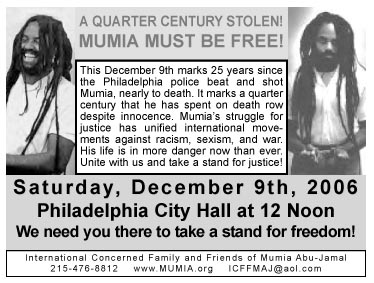
From The Free Mumia Abu-Jamal Coalition, NYC:
Sisters and Brothers:
Saturday, December 9th, will mark the 25th year of Mumia's incarceration, and the 25th year of his RESISTANCE, right in the bowels of the Beast. What an example of resistance Mumia has provided -- refusing to be silenced, learning, teaching, encouraging, engaged in struggle and strategy for resistance every minute of his life.
We, too, are part of that resistance!
Let's join together on Saturday December 9th in Philadelphia to mark this extremely important anniversary, when the enemy decided to make its ultimate move on a heroic revolutionary brother and leader.
We will be gathering at 12 noon at Philadelphia's City Hall to march to the AFSC building on 15th Street and Cherry.
Tuesday, November 07, 2006
Petition Drive to name a street in Harlem in honor of Mumia
HARLEM Can Help SAVE MUMIA!
Petition Drive to name a street in Harlem in honor of
MUMIA ABU-JAMAL
Kick-Off Petitioning Drive :
Saturday, November 11th at Noon
St. Mary's Episcopal Church
521 West 126th Street
in the Village of Harlem
This sign of the street named for Mumia in a prominent Parisian suburb demonstrates the French will to free Mumia.
And now Harlem's strong resolve to give Mumia a place in its heart will help set him free.
Cultural Performances by songbird duo: Desiree Gorndon & Sala Cyril
This would be a good time to wear your Mumia button and t-shirt.
Come out and make history! We're going to hit the streets—so bring your clipboards & pens—and wear comfortable shoes!
(Nearest subway is #1 to 125th Street.)
Petition Drive to name a street in Harlem in honor of
MUMIA ABU-JAMAL
Kick-Off Petitioning Drive :
Saturday, November 11th at Noon
St. Mary's Episcopal Church
521 West 126th Street
in the Village of Harlem
This sign of the street named for Mumia in a prominent Parisian suburb demonstrates the French will to free Mumia.
And now Harlem's strong resolve to give Mumia a place in its heart will help set him free.
Cultural Performances by songbird duo: Desiree Gorndon & Sala Cyril
This would be a good time to wear your Mumia button and t-shirt.
Come out and make history! We're going to hit the streets—so bring your clipboards & pens—and wear comfortable shoes!
(Nearest subway is #1 to 125th Street.)
Sunday, November 05, 2006
Pam Africa Turns Sixty!
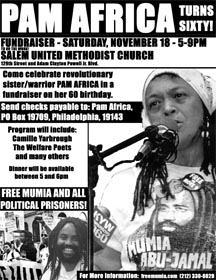 Pam Africa, Director of International Concerned Family & Friends of Mumia Abu-Jamal, is turning 60!
Come celebrate this revolutionary sister/warrior at a fundraiser,
Saturday, November 18th from 5-9pm at the Salem United Methodist Church at 129th Street and Adam Clayton Powell Jr. Boulevard in Harlem, NYC.
Donate to the work of ICFFMAJ, checks payable to:
Pam Africa
PO Box 19709
Philadelphia, 19143
The program will include Camille Yarbrough, The Welfare Poets, and many others.
Dinner will be available between 5 and 6pm
For more information visit www.freemumia.com.
or call (212)330-8029
Download the flyer for the event here.
Legal Update
Mumia's attorney, Robert R. Bryan, recently announced the filing of a new brief in the case.
From Atty. Bryan's letter:
On October 23, 2006, the Fourth-Step Reply Brief of Appellee and Cross-Appellant, Mumia Abu-Jamal was submitted to the U.S. Court of Appeals for the Third Circuit, Philadelphia. (Abu-Jamal v. Horn, U.S. Ct. of Appeals Nos. 01-9014, 02-9001.) It is attached...
The brief is of enormous consequence since it goes to the essence of our client's right to a fair trial, due process of law, and equal protection of the law, guaranteed by the Fifth, Sixth, and Fourteenth Amendments to the U.S. Constitution.
To read the brief in full, go to http://www.freemumia.com.
From Atty. Bryan's letter:
On October 23, 2006, the Fourth-Step Reply Brief of Appellee and Cross-Appellant, Mumia Abu-Jamal was submitted to the U.S. Court of Appeals for the Third Circuit, Philadelphia. (Abu-Jamal v. Horn, U.S. Ct. of Appeals Nos. 01-9014, 02-9001.) It is attached...
The brief is of enormous consequence since it goes to the essence of our client's right to a fair trial, due process of law, and equal protection of the law, guaranteed by the Fifth, Sixth, and Fourteenth Amendments to the U.S. Constitution.
To read the brief in full, go to http://www.freemumia.com.
Sunday, October 22, 2006
Revisioning John Brown
REVISIONING JOHN BROWN — paper prepared by Mumia Abu Jamal
“HIS TRUTH IS MARCHING ON” for a public discussion at Carnegie Mellon, Pittsburgh, Oct. 2, 2006
John Brown poses difficult and undeniable problems for us. For some like Staughton Lynd his violence and his authoritarian nature, indeed his profoundly disturbing certainty of his mission ordained by god, makes him a troubling model for the challenges of our hour. This is especially so, for many of us who feel the urgent need for Black and White social movements providing the energy for true social change. At the cross roads stands the shade of John Brown who blocks the way forward unless and until we can make peace with the ghost of this uniquely American warrior. That is because we have tended to remember Brown, if at all, as this God intoxicated mad man. In our minds his eyes flash lighting and his white beard flows with his rage, his teeth barred with malevolence. For if he is indeed mad then he may be safely jettisoned to the netherworld of otherness for we are sane. John Brown was mad.
But are we not selective in our revulsion at needless violence? In Washington DC the imperial capital, there stands a statue — petina green with time — honoring none other than Nathan Bedford Forrest who as a confederate general in the civil war staged the infamous Fort Pillow massacre on April 13th 1864 where mostly Black union soldiers were murdered in cold blood, after their surrender. Moreover Forrest became a leading force in the post war US terrorist group known as the Ku Klux Klan. Yet there his statue stands to this very day on honored ground. Why one wonders should we bring up Forrest when discussion Brown? What could this possibly mean when thinking of Blacks and Whites working together to build a social change movement?
If we are honest then we must recognize that the common nexus is violence, but that is not all. The central theme is race. General Nathan Bedford Forrest fought both during and after the Civil War for White Nationalism and Black subordination. He fought for the freedom to enslave others. John Brown fought both in Kansas and in Harpers Ferry against slavery and for Black freedom. Only in a nation deeply committed to white nationalism and white supremacy would Forrest have statues built to his memory enshrined in the national capital no less, and Brown be remembered—if at all—as a madman. It is only in this context that Brown’s immense contribution can be discussed, for to do otherwise is to speak of him and of violence in a vacuum. Staughton Lynd straightforwardly addressed the John Brown of Pottawatomie Kansas and his group’s slaughter of five pro slavery men in May 1856. We should note, however, that Brown and his boys were part of a war in bleeding Kansas, a war to determine whether the territory would become a free state, or a slave state. And that violence, indeed horrific violence, was rampant on both sides. And the pro slavery side was winning. By using ruthless racist violence, terrorism and fear Kansas was tilting toward being a pro slavery state. Then came John Brown. Of Pottawatomie Workers World writer Shelly Ettinger recently wrote “At Pottawatomie on the night of May 24-25, 1856, John Brown led an armed band in a lightning raid against an encampment where he knew he’d find several of the worst of the Border Ruffians who were terrorizing the territory. When Brown and company rode off, they left the dead bodies of five racist thugs. The criminals Brown and his band killed had been responsible for many assaults and murders; they were also known for capturing Native women and forcing them into prostitution and sexually assaulting Free State women.” [Workers World, September 14, 2006) Pottawatomie changed the temper of the times. Kansas was still bleeding Kansas but it was not only anti-slavery blood that flowed.
It is not about violence. It is about on which side the violence was utilized. Violence in support of slavery was invisible. Violence in support of freedom was horrible. Speaking of slavery what was that but violence? It was violence made acceptable and invisible by the verbal violence of the law. The John Brown who worked for several months writing the Chatham constitution knew this. And in the preamble to that document made it abundantly clear what he thought of slavery. A position by the way that was agreed to by the scores of Black men who met with him at the Chatham convention in Canada.
Indeed this Chatham constitution did not merely contemplate freedom and slavery. In a call that reflects its foresight, it called for sexual equality; a remarkable achievement considering it was written and voted for in 1858.
In his words expressed in the declaration of liberty Brown observed that “slavery from its earliest inception was none other than a most barbarous unprovoked and unjustifiable war of one portion of its citizens upon another portion” unquote. This constitution was a declaration of war between two irreconcilable sides, slavery and freedom. John Brown chose freedom. Nor did he speak of something that would be alien in Black hearts; none other than Frederick Douglas eight years before the Chatham convention described enslaved captives as “prisoners of war in an enemy’s country, of a war too that is unrivaled for its injustice, cruelty and meanness.” Douglass unabashedly called for war against the slavery system and even after the civil war began he was a persistent and unrelenting critic of Lincoln for his failure to call for Black troops. And what of Lincoln? Lincoln, the man honored today as the great emancipator, derided Brown and took pains to distance himself and his party from Brown’s efforts. In a speech at the Cooper Institute in New York City on February 1860. Lincoln argued:
“You charge that we stir up insurrection among your slaves. We deny it. And what is your proof? Harpers Ferry. John Brown. John Brown was no republican and you have failed to implicate a single a republican in his Harpers Ferry enterprise.” Lincoln went on to compare Brown to lunatics and rageacides, drawing from glaring flawed examples abroad. Lincoln argued:
“John Brown’s effort was peculiar — it was not a slave insurrection, it was an attempt by white men to get up a revolt among slaves in which the slaves refused to participate. In fact it was so absurd that the slaves with all their ignorance saw plainly enough that it would not succeed. That affair in its philosophy corresponds with the many attempts related in history of the assassination of kings and emperors. An enthusiast broods over the oppression of a people till he fancies himself commissioned by heaven to liberate. He ventures the attempt which ends in little else than his own execution. Orsini’s.attempt on Louie Napoleon and John Brown’s attempt at Harpers Ferry were in their philosophy precisely the same.” — That was Abraham Lincoln.
Two years before his Cooper Institute speech in September 1858, Lincoln would exclaim, “I do not suppose that the most peaceful ultimate extinction [of slavery] would occur in less than a hundred years at the least.” As the famed Black historian Lerone Bennet has written if Lincoln had had his way: Oprah Winfrey, Martin Luther King jr., Jessie Jackson senior, Lena Horn, Booker T Washington, Thurgood Marshall, Duke Ellington, Muhammad Ali, Jessie Owens, Louie Armstrong, WC Handy, Hank Aaron, Maya Angelou, Debbie Allen, Benjamin Quarles, Josephine Baker, Mary McCloud Bethune, Ralph Bunch, Malcolm X. Rosa Parks, Leontyne Price, Bessie Smith, Walter White, Madame CJ Walker, Maxine Waters, Count Basie, Gwendolyn Brooks, Ida B Wells-Barnett, Richard Wright, Alex Haley, and even Clarence Thomas, would have been born in slavery.
John Brown changed that. His sole surviving comrade Osborn Anderson in his remarkable book “A Voice from Harpers Ferry” writes a far different history than the professionals. For one thing he was there. And barely escaped with his life. For another he was a revolutionary who knew the principals. He argues that Harpers Ferry could have had a completely different ending for those men and the nation had Brown been less solicitous of his hostages. Anderson wrote “that hundreds of slaves were ready and would have joined in the work had Captain Brown’s sympathies not been aroused in favor of the families of his prisoners, and that a very different result would have been seen in consequence there is no question. There was abundant opportunity for him and the party to leave a place in which they held entire sway and possession before the arrival of the troops, and so cowardly were the slave holders proper that from Colonel Lewis Washington the descendant of the father of his country (General George Washington) they were easily taken prisoners. They had not pluck enough to fight nor to use the well loaded arms in their possession. But were concerned rather in keeping a whole skin by parlaying or by spilling cowardly tears to excite pity, as did Colonel Washington and as in that way escape merited punishment. No, the conduct of the slaves was beyond all praise, and could our brave old captain have steeled his heart against the entreaties of his captives or shut up the fountains of his sympathies against their families, could he for the moment have forgotten them in the selfish thought of his own friends and kindred, or by adhering to the original plan, have left the place and thus looked forward to the prospective freedom of the slaves, hundreds ready and waiting would have been armed before 24 hours had elapsed.”— Osborn Anderson, as one of the Black and White revolutionaries who tried to seize Harpers Ferry and thus fully cognizant of the failures of that effort, yet also saw the national impact of Brown’s work as setting the light to the fuse that would blast slavery into the trash can of history.
In Anderson’s words published in 1859, “As it was even the noble old man’s mistakes were productive of great good. The fact of which the future historian will record without the embarrassment attending its present narration. John Brown did not only capture and hold Harpers Ferry for 20 hours, but he held the whole south, he captured President Buchanan and his cabinet, convulsed the whole country, killed Governor Wise and dug the mine and laid the train which will eventually dissolve the union between freedom and slavery, the rebound reveals the truth, so let it be. Two years after Anderson’s words were on the page, uniformed men were marching with John Brown’s name on their lips as the Civil War dissolved the union between freedom and slavery.
If we go into any Black neighborhood today whether north south, Midwest or west, and asked the question which three white men are most admired I would wager that most would answer with perhaps the following 1) Jesus 2) John F Kennedy and three John Brown. I grew up in a project home where my mother had a painting of a blue eyed Jesus next to a photo of John F Kennedy on the living room wall. Only after his 1968 assassination did the face of Martin Luther King Jr. get placed in the middle. The point is that in Black memory John Brown holds a treasured place. His example, his sacrifice, and yes, his fight against slavery, made him a name that would not be forgotten. That is because blacks know almost instinctively that whites who would put their lives on the line for Blacks are rare creatures. Yet whites try their damndest to forget him, remember “he’s crazy.” How we reconcile his memory and his meaning for America will go a long way toward determining, whether, how and indeed if we work together to try to go about social change. Comes down to something that is also incredibly rare and that is trust. During the 60’s as Staunton Lynd remembers, Blacks in SNCC or the Student Nonviolent Coordinating Committee, urged their white members to leave for a few years while both Blacks and Whites “got it together.” As he notes those few years turned into decades and don’t seem any closer even as we open a new century. Later in the 60’s and early 70’s a group tried to aspire to John Brown’s high standard: the SDS or the students for a democratic society. As a member of the formation has recently noted, it broke from within chiefly because of the toxin of white supremacy. David Gilbert, writing of the split informs us, “SDS split apart along the basic fault line of the US bedrock of white supremacy. Between the desire for a potential majority base among white Americans and the urgent need for militant solidarity with Black and other third world struggles, one side invoking a Euro centric Marxism, said that the “revolution was about the working class” and used that as a left cover for retreat from fighting alongside Vietnam and the Panthers, claiming all nationalism is reactionary. The other side inspired by Marxist- led third world struggles rightly saw solidarity with national liberation as a priority for any revolutionary movement worthy of that name. However we wrongly abandoned efforts to organize significant numbers of white people, which also limited our base for anti-racist activism.” “That is from No Surrender — writings from an anti-imperialist, David Gilbert. The children who claim John Brown’s paternity could not measure up to the man. As long whites can opt out of a true revolutionary movement and the state will provide every opportunity, then they will do so, especially when the forces of repression ratchet up the pressure. In the MOVE organization when the conflict between the state and the organization hardened we saw whites and other races peel away from the movement, leaving its mostly Black core. When the going gets rough Whites get going, it seems.
That was the meaning and intent of the killing of a white housewife from Detroit named Viola Liuzzo slain by the Klan in Alabama but also defamed by the FBI for the capital crime of being like John Brown, a nigger lover. In a white supremacist state there is no greater crime than a white national can commit. Consider if you will the main offense for which John Brown was convicted, sentenced and executed for “treason” — this for a man who fought successfully for the inclusion of an article in the 1858 Chatham Constitution over objection which forbade any attempt to overthrown any state or the federal government. Brown in defense of article 46 argued “the old flag is good enough for me; under it freedom was won from the tyrants of the old world for white men, now I intend to make it do duty for Black men. By so doing he betrayed whiteness and earned the moniker ‘mad’”
John Brown certainly lacked a democratic sense — one that is virtually always lacking in a military structure. He was also a man drunk with a certainty of his mission from god. Yet so too was Martin Luther King. Staughton Lynd’s Zapatista visions, does give us valuable insight into another way of living in the world. It is refreshing such democracy as practiced not by the people so much as so called leaders; we see such things so rarely today. We can all learn from the struggles in the south, from Latin America, where we find indigenous led and women led formations that are deeply rooted in the community. The ghost of John Brown stands between us even after one hundred and fifty years. How we remember him, and indeed —if —we remember him has impact on what future we will have. Was he mad? Or was he inspired by the burning fire of freedom? How we answer that question will determine whether he will go in peace or continue to haunt us into our future.
From death row this is Mumia Abu Jamal.
“HIS TRUTH IS MARCHING ON” for a public discussion at Carnegie Mellon, Pittsburgh, Oct. 2, 2006
John Brown poses difficult and undeniable problems for us. For some like Staughton Lynd his violence and his authoritarian nature, indeed his profoundly disturbing certainty of his mission ordained by god, makes him a troubling model for the challenges of our hour. This is especially so, for many of us who feel the urgent need for Black and White social movements providing the energy for true social change. At the cross roads stands the shade of John Brown who blocks the way forward unless and until we can make peace with the ghost of this uniquely American warrior. That is because we have tended to remember Brown, if at all, as this God intoxicated mad man. In our minds his eyes flash lighting and his white beard flows with his rage, his teeth barred with malevolence. For if he is indeed mad then he may be safely jettisoned to the netherworld of otherness for we are sane. John Brown was mad.
But are we not selective in our revulsion at needless violence? In Washington DC the imperial capital, there stands a statue — petina green with time — honoring none other than Nathan Bedford Forrest who as a confederate general in the civil war staged the infamous Fort Pillow massacre on April 13th 1864 where mostly Black union soldiers were murdered in cold blood, after their surrender. Moreover Forrest became a leading force in the post war US terrorist group known as the Ku Klux Klan. Yet there his statue stands to this very day on honored ground. Why one wonders should we bring up Forrest when discussion Brown? What could this possibly mean when thinking of Blacks and Whites working together to build a social change movement?
If we are honest then we must recognize that the common nexus is violence, but that is not all. The central theme is race. General Nathan Bedford Forrest fought both during and after the Civil War for White Nationalism and Black subordination. He fought for the freedom to enslave others. John Brown fought both in Kansas and in Harpers Ferry against slavery and for Black freedom. Only in a nation deeply committed to white nationalism and white supremacy would Forrest have statues built to his memory enshrined in the national capital no less, and Brown be remembered—if at all—as a madman. It is only in this context that Brown’s immense contribution can be discussed, for to do otherwise is to speak of him and of violence in a vacuum. Staughton Lynd straightforwardly addressed the John Brown of Pottawatomie Kansas and his group’s slaughter of five pro slavery men in May 1856. We should note, however, that Brown and his boys were part of a war in bleeding Kansas, a war to determine whether the territory would become a free state, or a slave state. And that violence, indeed horrific violence, was rampant on both sides. And the pro slavery side was winning. By using ruthless racist violence, terrorism and fear Kansas was tilting toward being a pro slavery state. Then came John Brown. Of Pottawatomie Workers World writer Shelly Ettinger recently wrote “At Pottawatomie on the night of May 24-25, 1856, John Brown led an armed band in a lightning raid against an encampment where he knew he’d find several of the worst of the Border Ruffians who were terrorizing the territory. When Brown and company rode off, they left the dead bodies of five racist thugs. The criminals Brown and his band killed had been responsible for many assaults and murders; they were also known for capturing Native women and forcing them into prostitution and sexually assaulting Free State women.” [Workers World, September 14, 2006) Pottawatomie changed the temper of the times. Kansas was still bleeding Kansas but it was not only anti-slavery blood that flowed.
It is not about violence. It is about on which side the violence was utilized. Violence in support of slavery was invisible. Violence in support of freedom was horrible. Speaking of slavery what was that but violence? It was violence made acceptable and invisible by the verbal violence of the law. The John Brown who worked for several months writing the Chatham constitution knew this. And in the preamble to that document made it abundantly clear what he thought of slavery. A position by the way that was agreed to by the scores of Black men who met with him at the Chatham convention in Canada.
Indeed this Chatham constitution did not merely contemplate freedom and slavery. In a call that reflects its foresight, it called for sexual equality; a remarkable achievement considering it was written and voted for in 1858.
In his words expressed in the declaration of liberty Brown observed that “slavery from its earliest inception was none other than a most barbarous unprovoked and unjustifiable war of one portion of its citizens upon another portion” unquote. This constitution was a declaration of war between two irreconcilable sides, slavery and freedom. John Brown chose freedom. Nor did he speak of something that would be alien in Black hearts; none other than Frederick Douglas eight years before the Chatham convention described enslaved captives as “prisoners of war in an enemy’s country, of a war too that is unrivaled for its injustice, cruelty and meanness.” Douglass unabashedly called for war against the slavery system and even after the civil war began he was a persistent and unrelenting critic of Lincoln for his failure to call for Black troops. And what of Lincoln? Lincoln, the man honored today as the great emancipator, derided Brown and took pains to distance himself and his party from Brown’s efforts. In a speech at the Cooper Institute in New York City on February 1860. Lincoln argued:
“You charge that we stir up insurrection among your slaves. We deny it. And what is your proof? Harpers Ferry. John Brown. John Brown was no republican and you have failed to implicate a single a republican in his Harpers Ferry enterprise.” Lincoln went on to compare Brown to lunatics and rageacides, drawing from glaring flawed examples abroad. Lincoln argued:
“John Brown’s effort was peculiar — it was not a slave insurrection, it was an attempt by white men to get up a revolt among slaves in which the slaves refused to participate. In fact it was so absurd that the slaves with all their ignorance saw plainly enough that it would not succeed. That affair in its philosophy corresponds with the many attempts related in history of the assassination of kings and emperors. An enthusiast broods over the oppression of a people till he fancies himself commissioned by heaven to liberate. He ventures the attempt which ends in little else than his own execution. Orsini’s.attempt on Louie Napoleon and John Brown’s attempt at Harpers Ferry were in their philosophy precisely the same.” — That was Abraham Lincoln.
Two years before his Cooper Institute speech in September 1858, Lincoln would exclaim, “I do not suppose that the most peaceful ultimate extinction [of slavery] would occur in less than a hundred years at the least.” As the famed Black historian Lerone Bennet has written if Lincoln had had his way: Oprah Winfrey, Martin Luther King jr., Jessie Jackson senior, Lena Horn, Booker T Washington, Thurgood Marshall, Duke Ellington, Muhammad Ali, Jessie Owens, Louie Armstrong, WC Handy, Hank Aaron, Maya Angelou, Debbie Allen, Benjamin Quarles, Josephine Baker, Mary McCloud Bethune, Ralph Bunch, Malcolm X. Rosa Parks, Leontyne Price, Bessie Smith, Walter White, Madame CJ Walker, Maxine Waters, Count Basie, Gwendolyn Brooks, Ida B Wells-Barnett, Richard Wright, Alex Haley, and even Clarence Thomas, would have been born in slavery.
John Brown changed that. His sole surviving comrade Osborn Anderson in his remarkable book “A Voice from Harpers Ferry” writes a far different history than the professionals. For one thing he was there. And barely escaped with his life. For another he was a revolutionary who knew the principals. He argues that Harpers Ferry could have had a completely different ending for those men and the nation had Brown been less solicitous of his hostages. Anderson wrote “that hundreds of slaves were ready and would have joined in the work had Captain Brown’s sympathies not been aroused in favor of the families of his prisoners, and that a very different result would have been seen in consequence there is no question. There was abundant opportunity for him and the party to leave a place in which they held entire sway and possession before the arrival of the troops, and so cowardly were the slave holders proper that from Colonel Lewis Washington the descendant of the father of his country (General George Washington) they were easily taken prisoners. They had not pluck enough to fight nor to use the well loaded arms in their possession. But were concerned rather in keeping a whole skin by parlaying or by spilling cowardly tears to excite pity, as did Colonel Washington and as in that way escape merited punishment. No, the conduct of the slaves was beyond all praise, and could our brave old captain have steeled his heart against the entreaties of his captives or shut up the fountains of his sympathies against their families, could he for the moment have forgotten them in the selfish thought of his own friends and kindred, or by adhering to the original plan, have left the place and thus looked forward to the prospective freedom of the slaves, hundreds ready and waiting would have been armed before 24 hours had elapsed.”— Osborn Anderson, as one of the Black and White revolutionaries who tried to seize Harpers Ferry and thus fully cognizant of the failures of that effort, yet also saw the national impact of Brown’s work as setting the light to the fuse that would blast slavery into the trash can of history.
In Anderson’s words published in 1859, “As it was even the noble old man’s mistakes were productive of great good. The fact of which the future historian will record without the embarrassment attending its present narration. John Brown did not only capture and hold Harpers Ferry for 20 hours, but he held the whole south, he captured President Buchanan and his cabinet, convulsed the whole country, killed Governor Wise and dug the mine and laid the train which will eventually dissolve the union between freedom and slavery, the rebound reveals the truth, so let it be. Two years after Anderson’s words were on the page, uniformed men were marching with John Brown’s name on their lips as the Civil War dissolved the union between freedom and slavery.
If we go into any Black neighborhood today whether north south, Midwest or west, and asked the question which three white men are most admired I would wager that most would answer with perhaps the following 1) Jesus 2) John F Kennedy and three John Brown. I grew up in a project home where my mother had a painting of a blue eyed Jesus next to a photo of John F Kennedy on the living room wall. Only after his 1968 assassination did the face of Martin Luther King Jr. get placed in the middle. The point is that in Black memory John Brown holds a treasured place. His example, his sacrifice, and yes, his fight against slavery, made him a name that would not be forgotten. That is because blacks know almost instinctively that whites who would put their lives on the line for Blacks are rare creatures. Yet whites try their damndest to forget him, remember “he’s crazy.” How we reconcile his memory and his meaning for America will go a long way toward determining, whether, how and indeed if we work together to try to go about social change. Comes down to something that is also incredibly rare and that is trust. During the 60’s as Staunton Lynd remembers, Blacks in SNCC or the Student Nonviolent Coordinating Committee, urged their white members to leave for a few years while both Blacks and Whites “got it together.” As he notes those few years turned into decades and don’t seem any closer even as we open a new century. Later in the 60’s and early 70’s a group tried to aspire to John Brown’s high standard: the SDS or the students for a democratic society. As a member of the formation has recently noted, it broke from within chiefly because of the toxin of white supremacy. David Gilbert, writing of the split informs us, “SDS split apart along the basic fault line of the US bedrock of white supremacy. Between the desire for a potential majority base among white Americans and the urgent need for militant solidarity with Black and other third world struggles, one side invoking a Euro centric Marxism, said that the “revolution was about the working class” and used that as a left cover for retreat from fighting alongside Vietnam and the Panthers, claiming all nationalism is reactionary. The other side inspired by Marxist- led third world struggles rightly saw solidarity with national liberation as a priority for any revolutionary movement worthy of that name. However we wrongly abandoned efforts to organize significant numbers of white people, which also limited our base for anti-racist activism.” “That is from No Surrender — writings from an anti-imperialist, David Gilbert. The children who claim John Brown’s paternity could not measure up to the man. As long whites can opt out of a true revolutionary movement and the state will provide every opportunity, then they will do so, especially when the forces of repression ratchet up the pressure. In the MOVE organization when the conflict between the state and the organization hardened we saw whites and other races peel away from the movement, leaving its mostly Black core. When the going gets rough Whites get going, it seems.
That was the meaning and intent of the killing of a white housewife from Detroit named Viola Liuzzo slain by the Klan in Alabama but also defamed by the FBI for the capital crime of being like John Brown, a nigger lover. In a white supremacist state there is no greater crime than a white national can commit. Consider if you will the main offense for which John Brown was convicted, sentenced and executed for “treason” — this for a man who fought successfully for the inclusion of an article in the 1858 Chatham Constitution over objection which forbade any attempt to overthrown any state or the federal government. Brown in defense of article 46 argued “the old flag is good enough for me; under it freedom was won from the tyrants of the old world for white men, now I intend to make it do duty for Black men. By so doing he betrayed whiteness and earned the moniker ‘mad’”
John Brown certainly lacked a democratic sense — one that is virtually always lacking in a military structure. He was also a man drunk with a certainty of his mission from god. Yet so too was Martin Luther King. Staughton Lynd’s Zapatista visions, does give us valuable insight into another way of living in the world. It is refreshing such democracy as practiced not by the people so much as so called leaders; we see such things so rarely today. We can all learn from the struggles in the south, from Latin America, where we find indigenous led and women led formations that are deeply rooted in the community. The ghost of John Brown stands between us even after one hundred and fifty years. How we remember him, and indeed —if —we remember him has impact on what future we will have. Was he mad? Or was he inspired by the burning fire of freedom? How we answer that question will determine whether he will go in peace or continue to haunt us into our future.
From death row this is Mumia Abu Jamal.
Wednesday, October 18, 2006
Legal Update
Dear Friends:
Pursuant to a recent order of the U.S. Court of Appeals for the Third Circuit, Philadelphia, the 4th-Step Reply Brief will be filed October 23, 2006 on behalf of Mumia Abu-Jamal
Our objective is to win a new and fair trial in this case. At the conclusion of the retrial I want my client to walk out of the courtroom a free person.
We are grateful for your support in this great struggle against the death penalty and justice.
With best wishes,
Robert R. Bryan
Law Offices of Robert R. Bryan
2088 Union Street, Suite 4
San Francisco, California 94123
Lead counsel for Mumia Abu-Jamal
Pursuant to a recent order of the U.S. Court of Appeals for the Third Circuit, Philadelphia, the 4th-Step Reply Brief will be filed October 23, 2006 on behalf of Mumia Abu-Jamal
Our objective is to win a new and fair trial in this case. At the conclusion of the retrial I want my client to walk out of the courtroom a free person.
We are grateful for your support in this great struggle against the death penalty and justice.
With best wishes,
Robert R. Bryan
Law Offices of Robert R. Bryan
2088 Union Street, Suite 4
San Francisco, California 94123
Lead counsel for Mumia Abu-Jamal
Sunday, October 08, 2006
Call on NAACP's Crisis Magazine to Publish Mumia's Commentaries
During the months leading up to the execution of Stanley Williams, Bruce Gordon, the new President of the National Association of the Advancement of Colored People visited with the former Cripps leader turned advocate against gang violence saying he would do everything within his power to save his life. He also said upon his release, he could come and work for them in some capacity.
Well, as you know, he was executed on December 13th 2005 in spite of him being a redeemed man turned peacemaker and credited with saving thousands of lives by keeping tens of thousands of young people away from gang violence and away from the burgeoning prison industrial complex. Now obviously, the governor of California Arnold Schwarzenegger was going to do whatever was politically in his best interest and the NAACP cannot be held responsible for the cold-blooded execution of Mr. Williams, however, it is our contention that the NAACP leadership and organization did to little to late to help save his life. We don't want to see that same scenario played out in Mumia's.case. The NAACP passed a strong Emergency Resolution reaffirming its opposition against the death penalty and in affirmation of Mumia's right to a fair trial and subsequent release thereafter.
The Free Mumia Coalition deems it more than appropriate at this time in Mumia's case for the NAACP's Crisis magazine to begin publishing Mumia's weekly commentaries. If they are serous about taking crucial steps that could get out the word about who Mumia is and what he represents to our people, then they shouldn't have the slightest problem about adding his gut wrenching columns to their monthly periodical. If a left wing radio station like Pacifica's WBAI can and has been doing so for number of years than why not the Crisis.
If you feel as we do, then draw up a brief courteous letter stating how you feel the readers would enjoy seeing what Mumia has to say on many of the important issues of the day. Write to Victoria L. Valentine at: thecrisiseditorial@naacpnet.org or
The Crisis
7600 Georgia Avenue NW Suite 405
Washington, DC 20012
It's crucial the NAACP and anyone connected to it not run and hide behind this issue. As a people can cannot afford it if we expect to receive any sort of justice within our own lifetime.
No Justice No Peace!
Well, as you know, he was executed on December 13th 2005 in spite of him being a redeemed man turned peacemaker and credited with saving thousands of lives by keeping tens of thousands of young people away from gang violence and away from the burgeoning prison industrial complex. Now obviously, the governor of California Arnold Schwarzenegger was going to do whatever was politically in his best interest and the NAACP cannot be held responsible for the cold-blooded execution of Mr. Williams, however, it is our contention that the NAACP leadership and organization did to little to late to help save his life. We don't want to see that same scenario played out in Mumia's.case. The NAACP passed a strong Emergency Resolution reaffirming its opposition against the death penalty and in affirmation of Mumia's right to a fair trial and subsequent release thereafter.
The Free Mumia Coalition deems it more than appropriate at this time in Mumia's case for the NAACP's Crisis magazine to begin publishing Mumia's weekly commentaries. If they are serous about taking crucial steps that could get out the word about who Mumia is and what he represents to our people, then they shouldn't have the slightest problem about adding his gut wrenching columns to their monthly periodical. If a left wing radio station like Pacifica's WBAI can and has been doing so for number of years than why not the Crisis.
If you feel as we do, then draw up a brief courteous letter stating how you feel the readers would enjoy seeing what Mumia has to say on many of the important issues of the day. Write to Victoria L. Valentine at: thecrisiseditorial@naacpnet.org or
The Crisis
7600 Georgia Avenue NW Suite 405
Washington, DC 20012
It's crucial the NAACP and anyone connected to it not run and hide behind this issue. As a people can cannot afford it if we expect to receive any sort of justice within our own lifetime.
No Justice No Peace!
RBG Street Scholars "Free Mumia Abu-Jamal" Tribute
Go to youtube page
Check out the RBG Street Scholars Free Mumia Tribute Blog at:
rbgstreetscholarsthinktank.blogspot.com
Tuesday, September 26, 2006
Mumia Supporters Confront Philadelphia City Council on False Statements
On September 21, 2006 a group of activists representing the International Concerned Family and Friends of Mumia Abu-Jamal and the Free Mumia Abu-Jamal Coalition (NYC) came to the City Council of Philadelphia to demand that Council members rescind a resolution they passed last May. That resolution denounced the naming of a street in honor of Mumia Abu-Jamal on April 29, 2006 in Saint-Denis, France and included false and prejudicial material about Jamal.
Read more
Read more
Thursday, September 21, 2006
Activists Demand Philly City Council Rescind Resolution
Mumia supporters are travelling to Philadelphia today to demand that the City Council Rescind its May 25 Resolution.
On May 25, 2006 the City Council of Philadelphia unanimously passed a resolution supporting US HouseCongressional Resolution 407 which denounced the naming of a street in Mumia's honor in Saint-Denis, France, called for rescinding the name, and demanded that the French Government force Saint-Denis to withdraw the name rue Mumia Abu-Jamal if it refused to do so on its own.
Additionally, the Philadelphia resolution presented several lies without any challenge, fully prejudicing the public's view of Mumia's, presenting him as a cold-blooded murderer who has exhausted all his constitutional rights to appeal, and is now legally supposed to be executed.
-- the scenario the House Resolution presents of how Mumia shot Officer Faulkner in the back four times with his gun has never before been presented and is a newly concocted version meant to create a vicious image of Mumia.
-- the House Resolution states that Mumia was convicted and sentenced by a jury of his peers, a statement that contradicts Amnesty International's view (and the view of many other human rights and legal organizations) that Mumia was denied the right to have proportional representation of African-Americans on his jury by systematic and illegal exclusion of Black jurors, a practice that has been ruled by the US Supreme Court a basis for a new trial (the Batson ruling). In fact, the Third Circuit Court of Appeals, on December 5, 2006 granted Mumia the right to appeal the issue of racial bias in jury selection, and that issue is now the center of Mumia's appeal.
-- the Philadelphia City Council's assertion that Mumia has "exhausted all legal appeals" flies in the face of the reality that the case is currently being appealed before the Third Circuit Court of Appeals, and three issues have been granted by that court for appeal.
Neither ignorance nor prejudice justifies the outrageous falsehoods asserted in a a resolution, that though ridiculous in challenging another government's sovereignty, does harm to public support for Mumia's right to have a new and fair trial. The House of Representatives, the City Council of Philadelphia, and the Pennsylvania Senate Resolution all contain serious distortions of the reality of Mumia Abu-Jamal's case and embody reckless language and practice by elected legislators. They are meant to deny internationally honored political prisoner and death row inmate, Mumia Abu-Jamal, his right, based on well-documented denial of his rights by US Constitution and International Law, to a new and fair trial.
On May 25, 2006 the City Council of Philadelphia unanimously passed a resolution supporting US HouseCongressional Resolution 407 which denounced the naming of a street in Mumia's honor in Saint-Denis, France, called for rescinding the name, and demanded that the French Government force Saint-Denis to withdraw the name rue Mumia Abu-Jamal if it refused to do so on its own.
Additionally, the Philadelphia resolution presented several lies without any challenge, fully prejudicing the public's view of Mumia's, presenting him as a cold-blooded murderer who has exhausted all his constitutional rights to appeal, and is now legally supposed to be executed.
-- the scenario the House Resolution presents of how Mumia shot Officer Faulkner in the back four times with his gun has never before been presented and is a newly concocted version meant to create a vicious image of Mumia.
-- the House Resolution states that Mumia was convicted and sentenced by a jury of his peers, a statement that contradicts Amnesty International's view (and the view of many other human rights and legal organizations) that Mumia was denied the right to have proportional representation of African-Americans on his jury by systematic and illegal exclusion of Black jurors, a practice that has been ruled by the US Supreme Court a basis for a new trial (the Batson ruling). In fact, the Third Circuit Court of Appeals, on December 5, 2006 granted Mumia the right to appeal the issue of racial bias in jury selection, and that issue is now the center of Mumia's appeal.
-- the Philadelphia City Council's assertion that Mumia has "exhausted all legal appeals" flies in the face of the reality that the case is currently being appealed before the Third Circuit Court of Appeals, and three issues have been granted by that court for appeal.
Neither ignorance nor prejudice justifies the outrageous falsehoods asserted in a a resolution, that though ridiculous in challenging another government's sovereignty, does harm to public support for Mumia's right to have a new and fair trial. The House of Representatives, the City Council of Philadelphia, and the Pennsylvania Senate Resolution all contain serious distortions of the reality of Mumia Abu-Jamal's case and embody reckless language and practice by elected legislators. They are meant to deny internationally honored political prisoner and death row inmate, Mumia Abu-Jamal, his right, based on well-documented denial of his rights by US Constitution and International Law, to a new and fair trial.
Subscribe to:
Posts (Atom)